Trevor Price Printmaker
Can you explain the importance of being a member of The Royal Society of Printmakers?
I have been a member of the RSoP longer than I dare remember. I was elected very early in my career, when being a self-sufficient artist was a little fragile but very exciting. It’s not easy to get into the society so it was an honour to be elected. Its home is the Bankside Gallery which is in the shadow of Tate Modern on London’s South Bank. Being a member was a fantastic opportunity to get to know other practising printmakers, and to share experiences and knowledge. And perhaps most importantly in this solitary career, to make Printmaking mates. And there are friendships that has last several decades.
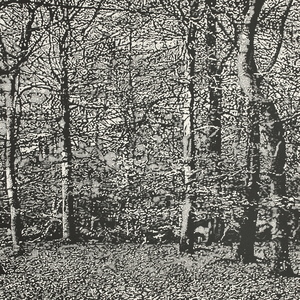
Woodland II. Drypoint and engraved relief print. Image and paper size 35.5×35.5cm
The Bankside Gallery is a fantastic central London space, and the organisation has several exhibitions there each year. But there have also been opportunities with the society to exhibit further afield including an exhibition and trip to Yinchaun in China. It was a exhibition of both Chinese and British Printmakers. I came back from there slightly humbled. The Chinese really know how to make prints. It was a turning point for me, and I decided in that moment to take longer making and if it meant making less that was fine. It’s not uncommon now for a single print of mine to take 2 to 3 months.
What was your role as Vice President of the RS?
Being Vice President was a moment of being a grown up. I was very proud to be asked, and alongside the President at the time Mychael Barratt, we embarked on two main objectives. More exhibition opportunities for our society at home, and more internationally. The biggest one thing done during that time was establishing the National Print Exhibition. It’s an open submission exhibition held annually to promote the best of printmaking. I see it primarily as a chance for young printmakers making exciting work to show what they have been doing. It has recently changed its name to International Print Exhibition, but primarily it’s still the the same thing with the same ethos.
You have won many Awards in your career. Take one and explain its importance?
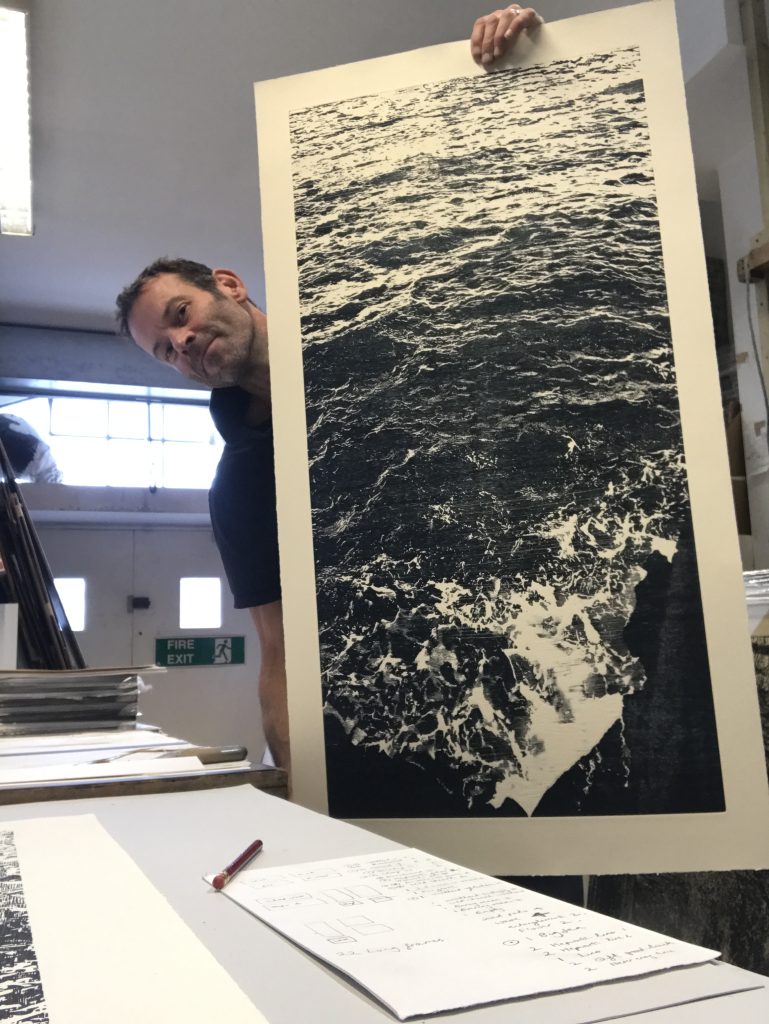
its importance? Last year I won the Viking Prize for Print at The Royal Academy of Arts Summer Exhibition. The annual exhibition has thousands of entries and so artists are always excited to be selected. Between the age of 28 to 38 I had 10 straight rejections. I am fairly sure I didn’t make 10 years of bad work, but I certainly didn’t get any luck with my entries. As all artists know, you need to be thick skinned sometimes, and not to take it personally. My luck with the Royal Academy of Arts seems now to have change. To win their print prize was a big deal for me and I won it with a large water themed woodcut called Rock n Roll. The whole edition of 100 sold out in the first week of the exhibition. The Royal Academy embrace the red dot, so there was a very long line of them beside my picture. The exhibition is seen by thousands and thousands of people, so the award was certainly a significant moment.
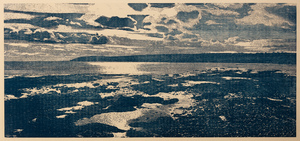
Meet me here tomorrow
How large can you produce your work?
I have a large press, which can take double imperial paper (112 x 76cm) so most of my prints are this scale. But a great friend of mine who’s opinion I value recently suggested I go bigger. He has a massive press and editions large works for some very well established artists that include Damien Hurst and Chris Le Brun. So, following his advice, and borrowing his press I made 2 very large woodcuts this year where the blocks are 124x89cm. That’s about the maximum…. now.
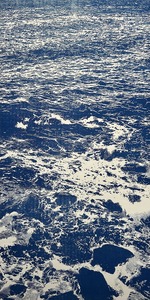 We need to come back to this place soon. 100x50cm woodcut
What are the restrictions you ask?
The size of the press, the size of a van (it must fit in a van!!), and my energy levels are what limits it getting bigger. Oh, and my patience. The process really tests my patience as there is a lot of mark making and it can be a slow meticulous process. Some days it feels far from creative, but I really believe it’s all about the time put in, and most days I am happy to do the time. Comment on your studio.
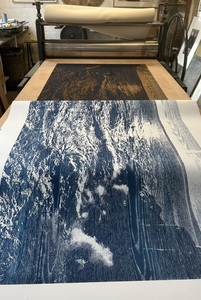
Wild West Printing
My studio is in the heart of the Cornish seaside town St. Ives. My studio is small but perfectly formed studio and has St. Ives Bay as it’s view. The house Ben Nicholson lived is is just to my right, so we share the same view. If you are familiar with his drypoint of St. Ives rooftops, you’ll know the view. I’m also just a two minute walk to the local surf beach. Useful in the summer for cooling off and useful the rest of the time for inspiration and distraction.
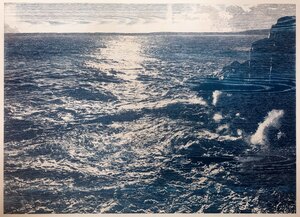
Wild West. 89x124cm Woodcut
Why is the sea so important in your work?
Unsurprisingly the sea is my primary art source. The ever-changing sea. It’s at it best in the late Autumn when the waves are bigger, the days are shorter, but the sunlight is low and dramatic. I have no doubt I will continue to make prints of the sea. They may get a bit bigger, and perhaps a little more abstracted, but the sea will continue to influence. My surroundings have always been the starting point. In my urban past I referenced the hustle and bustle of London’s train stations in my printmaking. My intention was to do every London train station, but then I got distracted by a woodland series. I may revisit the woodlands at some point soon.
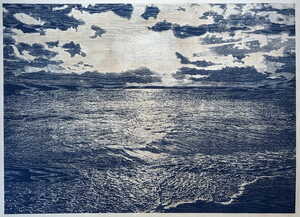
Let’s go and live by the ocean. Woodcut 124 x 89 cm
For art lovers can you give 5 hints to visiting St Ives?
If you were to visit St. Ives, then the Tate Gallery is a must see. You’ll always find Hepworth, Nicholson, Alfred Wallis, Patrick Heron, and others from the art establishment that was St. Ives in the 1940’s and 1950’s. Then there’s Barbara Hepworth’s Garden and studio. This is probably my personal favourite of the art things in St. Ives. The garden is skilfully maintained so that it’s always just slightly overgrown. Amongst the plants are her sculptures. They seem to make more sense in this natural environment. Art in a gallery can sometimes feel stuffy, over intellectual, and unapproachable. But in her garden, it seems fine to poke your head through a Hepworth hole and take a selfie. I love it.
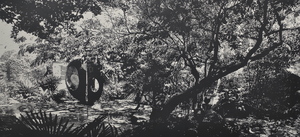
Hepworth’s Garden II
My workshop is one minutes’ walk up the hill from her garden, so inevitably her garden has featured in my printmaking. To date I have made 3 big prints of her garden.
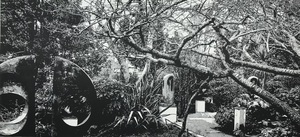
Hepworth’s Garden III
Each are relief prints. I have carved (primarily with an electric Dremel) and scratched polycarbonate sheets for these and rolled ink over the surfaces using a very large and heavy roller. There’s no need to go to the gym on editioning days. The platemaking is methodical (meaning it’s a little dull some days!) and time consuming, so with little room for error taking the first proof can be an anxious moment. At the top of the town is the Bernard Leach Pottery. The Leach Pottery was founded in 1920 by Bernard Leach and Shoji Hamada. It’s now a museum and a working pottery with courses for visitors. The best time to visit for art and music lovers is during the September festival. The bucket and spade tourists have left and there’s an influx of art lovers. Artists open their studio, and there’s all sorts of arty folk wandering around perhaps reciting poetry or giving impromptu jazz performances. There must be so many artists who dream of living in St Ives I am a Cornishman by birth, so to end up in St. Ives was not such a big leap, as it’s just 10 miles from my birthplace. But I did spend almost 30 years in London.
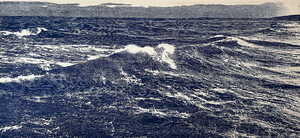
Let’s start our journey from this moment… woodcut 47x102cm
The return to Cornwall, and to St. Ives was a spur of the moment decision for me and my family. We loaded everything into a van, and what we couldn’t fit in we left behind. That was over ten years ago. To be honest it wasn’t the art that drew us to St. Ives. It was the sea the escape. I am so glad we made the move. It’s certainly help creatively but has also helped with my surfing skills.
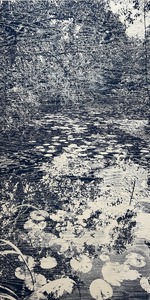
Water lilies (nymphaea) woodcut 50x100cm
Contact:
Trevor Price
Website: https://www.trevorpricestudios.com/
Email: trevorpriceartist@gmail.com
Deborah Blakeley, Melbourne, Australia
Interview by Deborah Blakeley, November 2026
Images on these pages are all rights reserved by Trevor Price

Think a colleague or friend could benefit from this interview?
Knowledge is one of the biggest assets in any business. So why not forward this on to your friends and colleagues so they too can start taking advantage of the insightful information the artist has given?
Other artists you may be interested in: