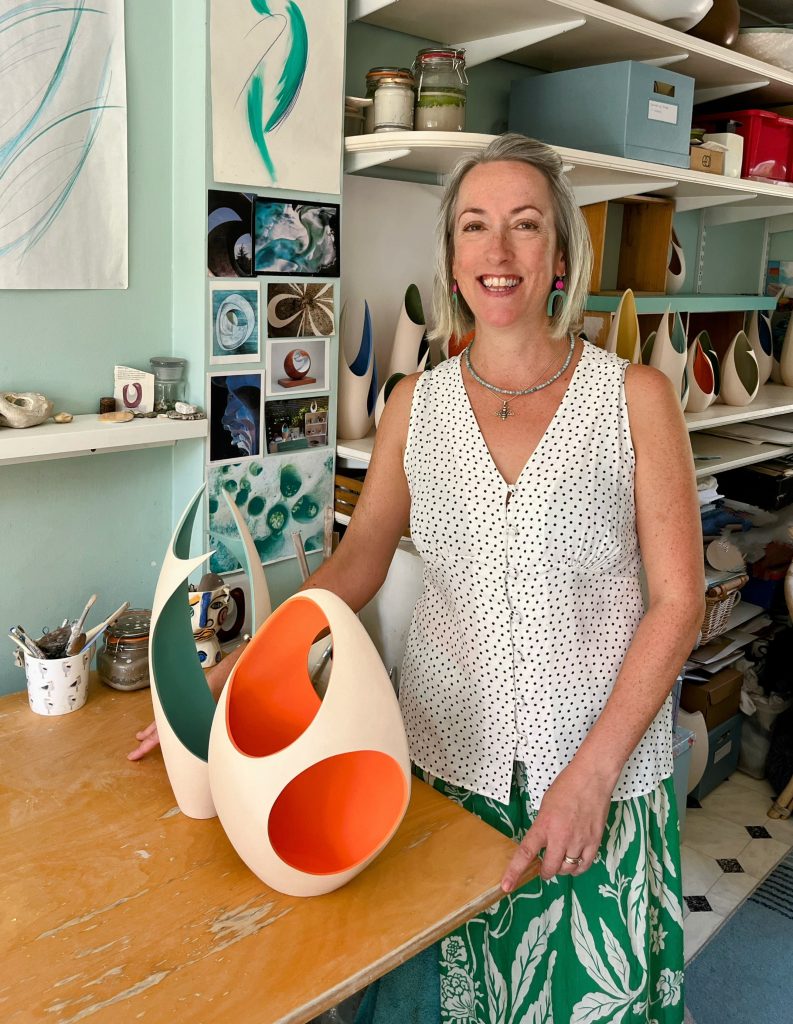
Sarah Hillman Ceramic Artist
What keeps you looking for new ways to explore space.
I always feel immersed in my surroundings, mesmerised by crashing waves on the shore or by the undulations of a sandy beach or swirling rock pools. I particularly love how sunlight impacts the natural environment, how a cloud casts a shadow across a field or highlights the contours of rolling hills. I find engaging with the natural world a constantly shifting, transient experience. A sunset is never static; I love looking up and seeing how the clouds change colours, how the light changes and shadows cast shift and evolve. I feel constantly inspired by this beautiful world we live in, an ever-changing visual landscape. It’s this shifting sensory experience that I try to capture within my work.
About four years ago we moved to Sussex, and I am very lucky to be on the edge of the beautiful South Downs and not too far from the sea. I love this stunning landscape, and how nature can sculpt and adapt the forms around it. Tactile pebbles on the beach or smooth driftwood which have been carved by the sea. The colour in my work is also inspired by the natural world; the stunning shades of the sea, a vibrant sunset or bright plants and flowers. Nature is a constant rich source of inspiration.
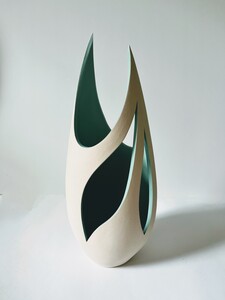
Waterfall Form
Are you restricted to the size of your work and why?
When I took up Ceramics at Farnham College in 1996, I instantly fell in love. I began pushing the clay to its limits by making large hand-built forms, then after my Masters in Cardiff I began to translate the sculptural elements of my work to smaller forms. I tend to work on a few pieces at any one time, usually of various sizes. I find the visual language between a collection of work naturally lends itself to a range of sizes. But ultimately, I like to make pieces that are accessible and can become part of someone’s home.
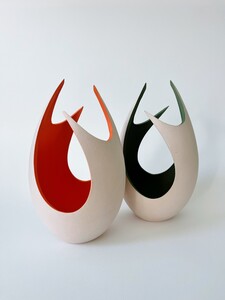
Splash Forms
Can you briefly explain the stages you take in producing a design piece?
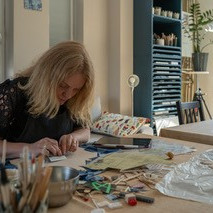
I have a series of press moulds I use for my work, which I made many years ago. I have always slab built as I find it the most effective way to make the initial form to then adapt. I make an enclosed form from the mould and I then hand cut each piece individually. I can often visualise the form before I start to cut, mapping lines with a wet brush before starting to remove sections and manipulate the piece. I’m often sketching ideas of how the lines will intersect, but ultimately my work comes to life in the cutting process.
Why do many of your works have the term pod in the title?
In naming my work, I often nod towards the natural world from where I draw influence. Tactile pebbles, seed pods and flower buds. The organic shape of the initial press moulded form is very much “pod” shaped, so the titles come from that.
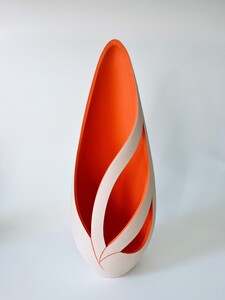
Flower Pod
What led you to place the colour on the inside rather than the outside?
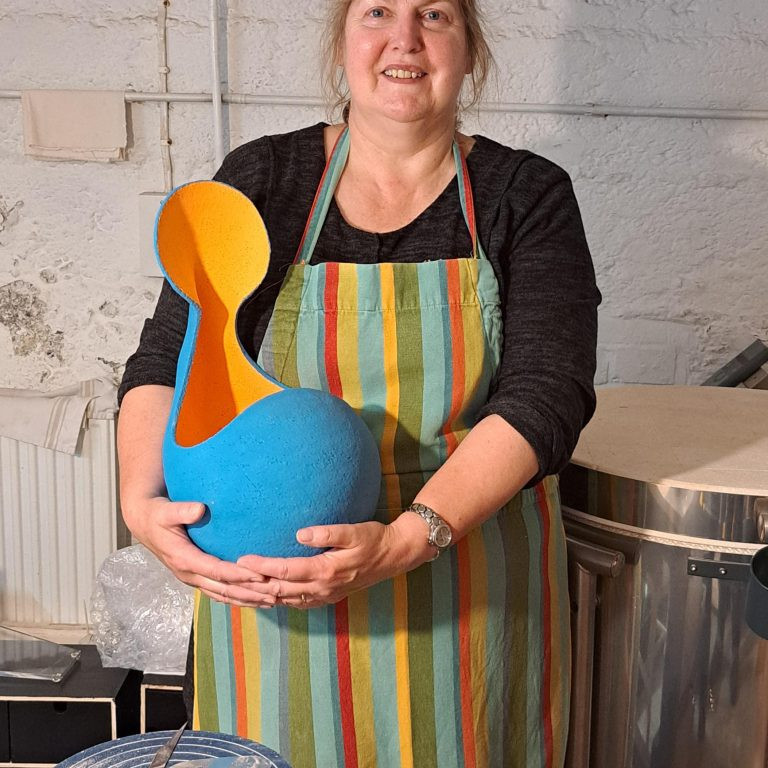
In my first London studio (at Kate Malone’s Balls Pond Studios) I was still experimenting with large scale sculptural shape and form. I wanted to further explore the interior space of the forms I was making, once I began putting the colour solely on the interior it brought a new dimension to the work. Anish Kapoor is an influence on my work, I love the way he creates perspective disorientation in his work using block colour.
Discuss the importance of the missing, in your work.
Exploring the negative space within the form began to become extremely important in my work. Leaving the external surface as the natural white clay body draws the viewer into the space within. Once the light and shadows interact, the whole visual experience becomes interactive. So, the negative space begins to hold as much significance as the physical form itself. The shifting perception of form becomes an interactive engagement from the viewer’s perspective; how the experience changes depending on the angle of view or the direction of light. While I was studying for my Masters, I stopped using glaze on my work and started exploring flat colour. The interior colours used on my work aim to absorb light to enhance the shadows and depth within the piece.
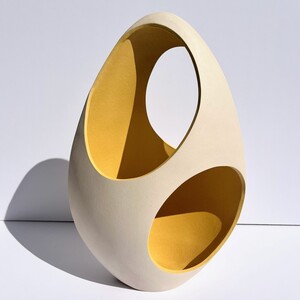
Flower Pod
Do you ever open your studio for Open Studio Days?
I was a resident at Cockpit Arts in Holborn for several years, during this time I took part in regular Open Studios, and large shows such as Origin at Somerset House. The Cockpit Arts community was a hugely important part of that time, and the open studios held twice a year were busy collaborate events.
After I moved out of Cockpit and began working alone from my home studio, I didn’t hold many Open Studios. However now based so close to the creative city of Brighton, I am hoping to start collaborating with Artists Open Houses events. I feel that exhibiting with a large group of makers for such events leads to their success.
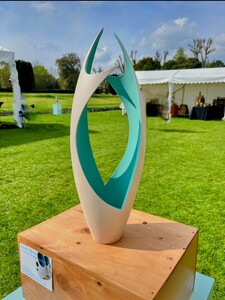
Potfest
Can you expand the importance of Potfest
Last year I took part in Potfest Glynde Place which was a fantastic experience. Potfest host many ceramic shows across the UK, and It was the first show I’d applied to in quite a few years. The shows have a selection process, and it leads to a high standard of work. I really enjoy exhibiting at shows as it’s a great opportunity to chat with other makers but more importantly to speak to people directly about my work. However, the shows require a lot of planning and preparation, which with three children can be a lot to juggle. There are many wonderful shows around the country which I hope to take part in once my children are a little older.
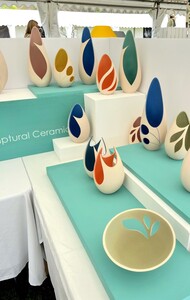 Discuss the importance of simplicity in your work?
The simplicity of my work has evolved over time – sometimes less really is more! Particularly when a sweeping line creates a strong contrast between the interior and exterior form, then the shadows cast become so significant. The consideration of how the interior lines intersect becomes the most important language. I am a huge fan of modernist abstract sculptors such as Barbara Hepworth and Henry Moore, both have such minimalist yet elegant sculptural work.
Comment on how your study at The Centre of Ceramic Study influenced your work.
It’s sometimes hard to believe I have been working with clay for 30 years. As mentioned, I began at Farnham College where I had a fantastic tutor, Andrew Rowley, who was hugely influential in my drive to pursue a career in Ceramics. I remember him saying to me that if I worked hard, I could make a name for myself, and giving me that encouragement and belief really stayed with me.
I went on to Nottingham Trent to do a BA in applied arts and from there on to The Centre for Ceramics Studies in Cardiff to take my Masters. It was during this time I studied alongside fellow makers such as Sara Moorehouse and Paul Wearing. It was an intense yet fascinating year really exploring the medium of clay with such an amazing group. I continued to work in a sculptural nature exploring movement and perception, and space and form.
After I’d completed my MA, I moved to London and joined Balls Pond Studios, then moved on to London Cockpit Arts. It was my 5-year residency at Cockpit that really helped me find my voice as a maker. Cockpit houses a vast number of mixed disciplines, while offering business support and mentoring. I was able to make contacts through the well attended Open Studios, which led to my work being selected for a television set loan for ITV while also working with the Royal Academy of Arts.
I am now settled in Sussex and work happily from my lovely home studio. I’m always looking for new ways to manipulate the clay and thirty years on, I never tire of seeing how far I can take such a versatile yet natural material.
Sarah Hillman
Contact:
Website: www.sarahhillmanceramics.com
Email: Sarah_hillman@hotmail.com
Deborah Blakeley, Melbourne, Australia
Interview by Deborah Blakeley, July 2026
Images on these pages are all rights reserved by Sarah Hillman

Think a colleague or friend could benefit from this interview?
Knowledge is one of the biggest assets in any business. So why not forward this on to your friends and colleagues so they too can start taking advantage of the insightful information the artist has given?
Other artists you may be interested in: