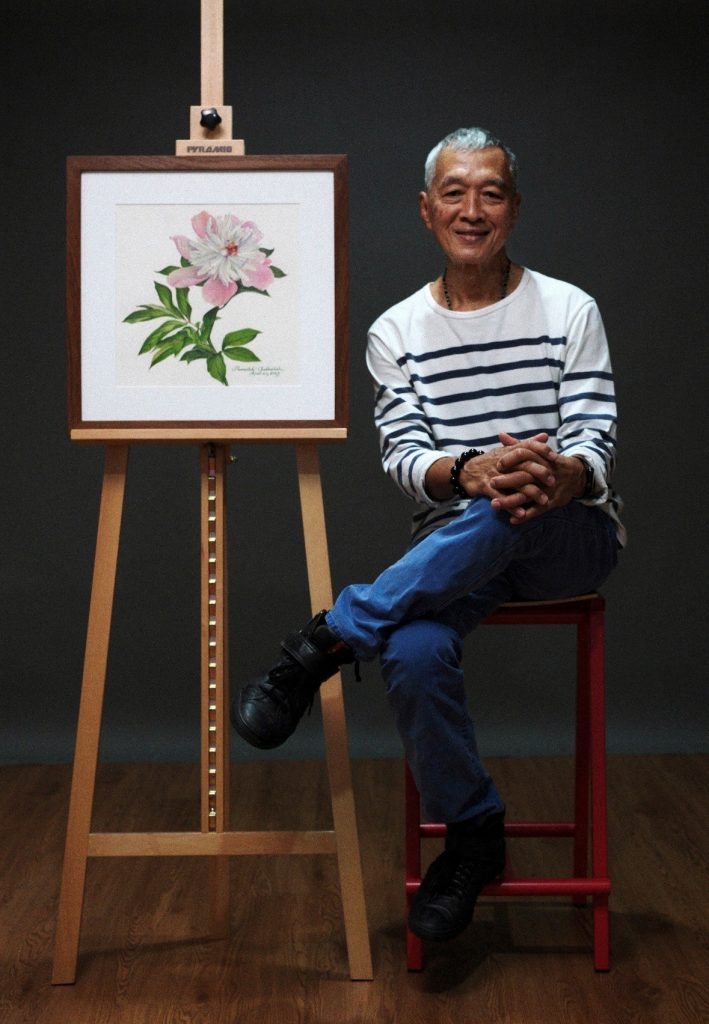
Phansakdi Chakkaphak Botanical Artist
When you began your studies (in Architecture) did you foresee your art to be so involved in botanical art?
After earning bachelor’s degrees in Industrial Design at Chulalongkorn University,Bangkok, and in Plastic and Graphic Art from the University of Illinois, Chicago in 1976. I end up my employee career as a creative director at McCann Erickson Thailand in Bangkok before I left my employment life for good in early 1990.
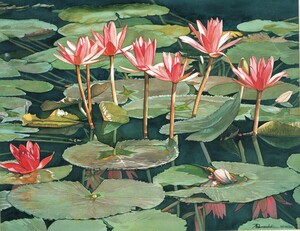
In 1984, when I lived in San Francisco I used watercolor to paint 5 paintings of water Lily to decorate my restaurant which my business partner and I decided to name the place ‘Water Lily Cafe’. 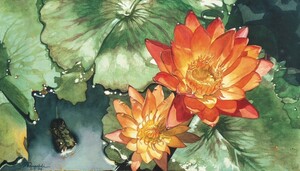
I have never had class in watercolour before. I enlarged the image from the post card size photos of water Lily that I took photographs from a water lily pond at Chulalongkorn University in Bangkok. I had no idea at all that they were the first set of my botanical art.
After I quit my job at 41 years old, I spent my time at the house of my Mentor, Arjarn Chakrabhand Posayakrit, Thai National Artist in Visual Arts.
What was the step that allowed you to become a freelance Botanical artist?
I went to visit my family and friends in San Francisco in 1991 and discovered botanical art at San Francisco Flower Show. I applied to join botanical work shop by Michele Meyer,the President of ASBA, at Golden Gate Park. I finished 5 artworks then the workshop ended.
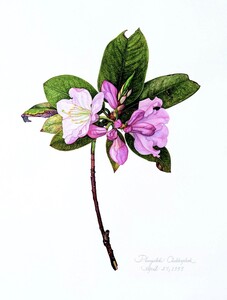
Rhododendron, the first botanical painting was selected by Mr. James White to be included in the exhibition ‘Flora 2000, International Juried Exhibition of the American Society of Botanical Artists, Longwood Gardens, Kennett Square, Pennsylvania, 2013. (Exhibition Catalogue)
Back in Thailand I have devoted my life creating only botanical art ever since. James White contacted me to send my artworks to be selected for the 9th Hunt Institute Exhibition. I declined, because I was just a beginner, I haven’t yet created any masterpiece.
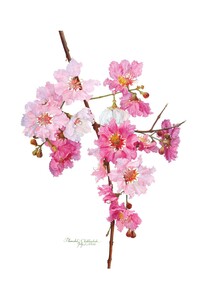
I waited until 15 years later, my artwork of Lagerstroemia Loudonii was selected to be included with the artwork of 40 botanical artists from 10 countries in the 14th International Exhibition of Botanical Art & Illustration, Hunt Institute of Botanical Documentation, Carnegie Mellon University, Pittsburgh, Pennsylvania, 2013. [Exhibition Catalogue]
Can you explain the importance of having your work both bought and in the Shirley Sherwood collection a winning her major prize?
Dr Shirley Sherwood, while on vacation visited a hotel hair salon in Bangkok where she was surprised to discover two of my original botanical paintings adorning the salon wall. She contacted me and started collecting my artworks.
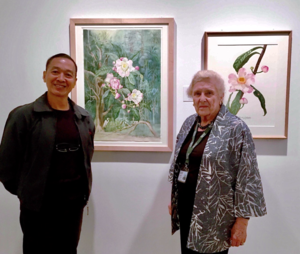
The day we first met, February 17, 2010, absolutely was the most important day of my botanical artist life.
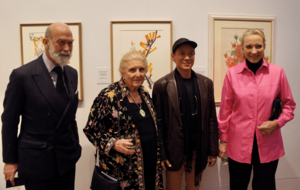
As of, 2026, her most prestigious collection holds 53 original works, selections of which are regularly exhibited at the Shirley Sherwood Gallery of Botanical Art at Royal Gardens Kew, London, and in several exhibitions outside UK.
Early February this year, Dr Shirley Sherwood face time called me and surprised me with the news that she had selected me as the winner of the Shirley Sherwood Award for Botanical Art 2026.
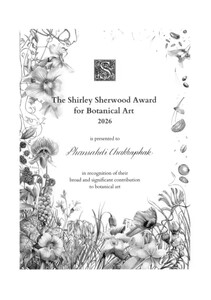
I am so humbled and so proud that my life achievement were honoured with her most prestigious award this year at the age of 77.
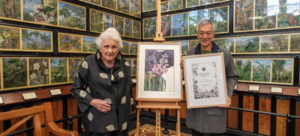
I went to accept the award’s certificate in person from Dr Shirley Sherwood on May 22, 2026
Your work ranges from the simplest flower Mouse-ear Scorpion Grass or Foret-me-knot to Prunus cerasoides Buch, discuss.
Mouse-ear Scorpion Grass, Forget -me-not, Prunus cerasoides and Walnut are in the set of 18 small paintings, 240×220 mm I did to illustrated in an article ‘The meaning of Plants’ for the Ploy Kam Petch magazine in Thailand.
The image was at the top half of a one page article in the magazine.
All 18 original framed paintings are in the Shirley Sherwood Collection.
On September 19, 1991, Arjarn Chakrabhand suggested to me to spend my free time using watercolour to paint still life of white roses in a glass vase.
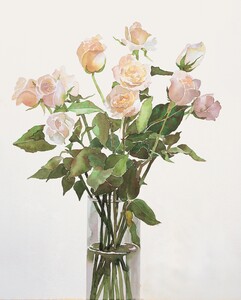
He advised me to paint freehand, to apply watercolour directly with no preliminary pencil sketch, I followed his advice painted watercolour on paper standing up right on an easel. He encouraged me to seriously continue to improve my skills.
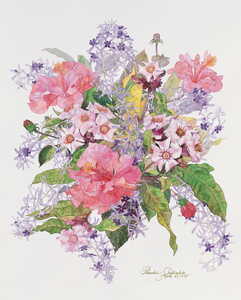
Short time later he introduced me to be an illustrator for a very popular magazine in Thailand. I became a well-known freelance watercolour artist painting still life flowers and plants. Knowing nothing about botanical art.
Arjarn Chakrabhand was kind enough to critique my artworks over the years, as I developed this technique, continually honing my skill and making it uniquely my own. He exhorted me to work hard, as it’s the only way to become a good artist.
I have devoted my life to his advice.
You also paint fruit and vegetables take one of each and discuss.
I visited Japan in November 2016. I saw rows of very big Japanese pine trees in front of the Summer Palace in Kyoto. I immediately wanted to paint the cone. I took lots of pictures with my iphone.
I started the painting in December 2016 and finished on the 25th July 2017. It was the painting that took the longest time for me to finish, because of the colouring of all the leaves.
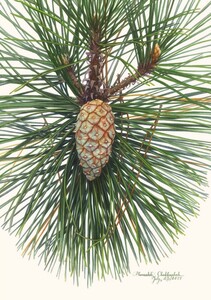
Japanese Pinecone: Watercolour on paper 515 x 375 mm, July25, 2017,
Shirley Sherwood Collection
I painted this simple set up painting for a TV production interviewing me while I was painting in my studio in Sriracha. I bought onions and garlics from the market near my house. This painting and Caribbean jewels Sapphire Blue were two of my artworks included in the 2015 selling exhibition “Work from Botanical Artists in the Collection of Dr. Shirley Sherwood OBE : Celebrating 25 Years of her Collection “ (catalogue) at the Jonathan Cooper Park Walk Gallery in London.
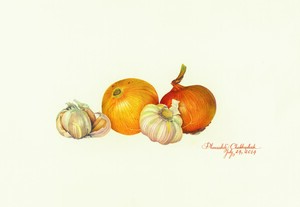
Onions and Garlic Gouache on paper 380 x 262 mm, July 24, 2014. Shirley Sherwood Collection
Comment on the importance of painting Thai plants for you.
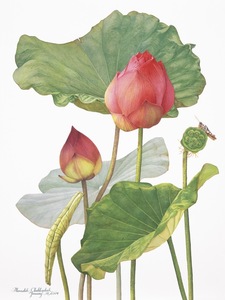
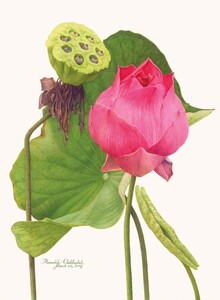
I paint plants I can easily find not because they are Thai plants. I paint lotus because everything of lotus fascinating me.
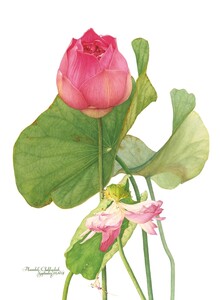
I have painted many of them not because lotus is Thai flowers and fortunately the Rajamangala Water Lily Institute that has plenty of beautiful water Lily and Lotus, is located in my hometown.
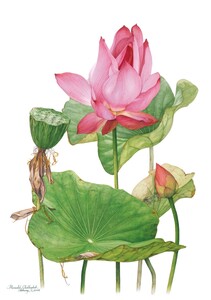
Asst. Prof. Dr. N . Nopchai Chansilp, the founder of the institute has honored me and named a new waterlily he bred after me.
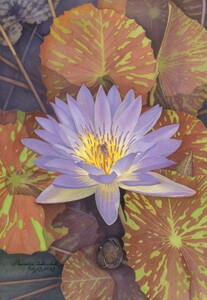
Water Lily ‘Phansakdi Chakkaphak’, Nymphaea ‘Phansakdi Chakkaphak’
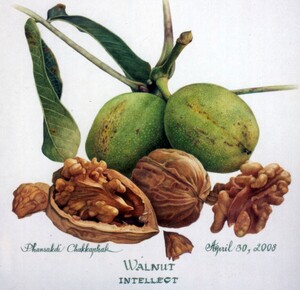
Discuss the way you have painted the three aspects of a walnut on the same painting.
Raw nut
Ripe nut
Nut ready to eat.
I included three aspects of walnut, raw nut, ripe nut and nut ready to eat, in the same painting because in the process of finding images of walnut, I chose images that have beautiful details to composed them in my painting.
Do you think your former design work has helped you with your botanical art?
I have been interested and had passion in flowers since I was very young, became a watercolor flower painter at 42 years old. Not only my former design works helped me with my botanical art. All of my life’s experiences to become who I am, everything I have interested and care about, my personal aesthetic taste and most of all, I was very fortunate to have my mentor, Arjarn Chakrabhand Posayakrit who gave me all advise an critiqued my artworks which tremendously helped me to improve my skill.
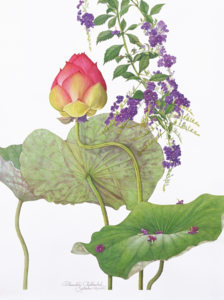
I can clearly READ my artwork and most importantly, know when to STOP. Then sign and date my artwork the day I finish.
Can you explain very briefly your painting technique?
I always start my painting with the FOCAL IMAGE first.
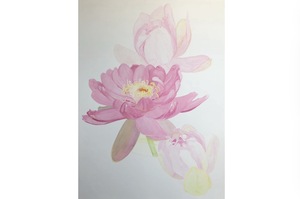
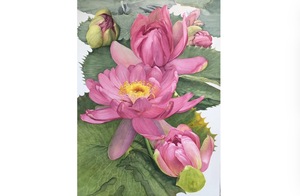
Carefully concentrate in applying first layer of watercolour direct on paper and continue to add more elements, composing my painting until I am happy with the total image.
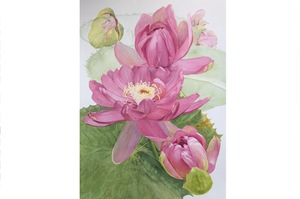
Gradually apply colours to add intensity of the whole image, capture every details and character of the plant, create depth and dimension of the total image until I am satisfying with everything and have the feeling that my process has reached the point to STOP.
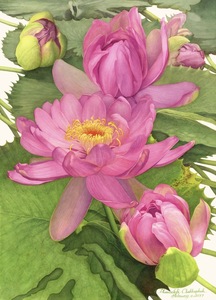
Carefully, final inspect everything then sign and date the finished painting.
What quality paper and paint do you use?
Acid free Fabriano Artistico Hot Pressed 640gms
Explain the importance of ‘Freshness’ in you work.
Arjarn Chakrabhand gave me a very important advice which I think has helped me to create ‘Freshness‘in my work. He told me ‘’ You must paint in natural light only. Do not paint at night time or even on the overcast day. You paint nature, only in natural light all colours you see are true colour. You must pay attention to be able to see all colours of what you are painting “ I have never paint in artificial light since. I am lucky to live in the part of the world that have no problem about natural light.
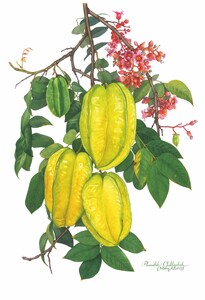
I realized that in natural light I can see all details, all characters and appearances of plant I am working on. I try my best to capture them with watercolour as much as I can in my artwork. Artificial lighting casts sharp shadow on the subject, kills complexion colours of freshness on the surface of real life and kills surrounding reflecting colours on the surfaces of effecting area that can be seen only in natural light.
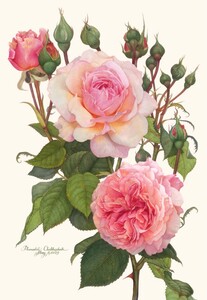
‘Exotic’ is a word, I would use for much of your work – discuss.
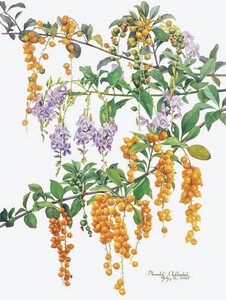
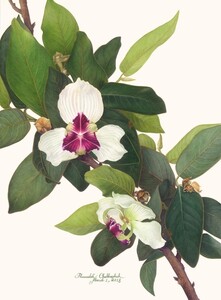
‘Exotic’ is the word of my impression when I see the actual flower or fruit and have immediately feeling of wanting to paint it at first sight.
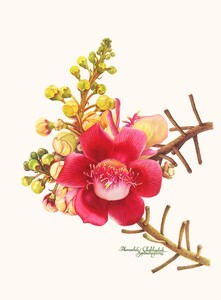
I do my best with all my skills and my aesthetic taste, concentrating and carefully working to capture that ‘Exotic’ feeling to appear on my finished artwork.
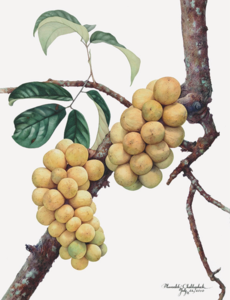
When do you add insects to your work?
I added insect in only 2 still life artworks for the magazine in 1997.
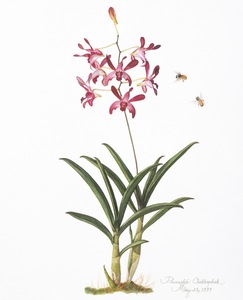
I added 2 bees only in one botanical art painting I did in botanical painting art work shop in San Francisco, 1999. One bee covers a magenta spot I accidentally made on the white background.
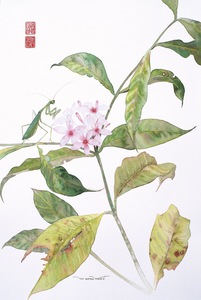
I added a Grasshopper in my Lotus painting in 2007.
Tell us about your book ‘Beauty in Bloom’ and how to obtain a copy.
‘Beauty in Bloom’ is my second book, came out when I was 60 years old in 2009.
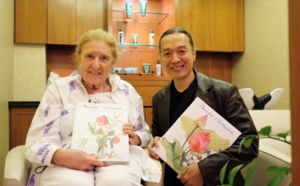
Content:
Foreword, Acknowledgement, My watercolor technique,
Part One: 10 years ( 1999 – 2009 ) of fascination with the marvelous charm of Beauty in Bloom that is so nourishing to the world and to my life.
Part Two: 8 years ( 1991 – 1999 ) of delight in still life watercolor painting of my best loved flowers.
Part Three: Flora to be harvested endlessly.
Bibliography, List of the Collectors, Index, Exhibitions, Phansakdi Chakkaphak
size: 298×235 mm, 308 pages.
Now available only at the museum shop on the 5th floor, Bangkok Art and Cultural Center(BACC),Bangkok,Thailand
My first book was ‘Everlasting Bloom’, not available.
Where do you find the blooms to paint?
I am not a Botanist! I just became a still life watercolour artist in 1991 at the age of 42 who loves to paint flowers. I painted flowers from my garden, vegetables, and fruits I bought from the morning market near my house or from places that not far from my studio because the flowers must be fresh for me to paint still life from start to finish.
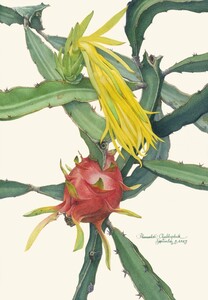
I found Dragon fruit in the garden of a coffee shop in Chieng Mai, Thailand.
I continue to paint from live when I turn to botanical art in 1999.
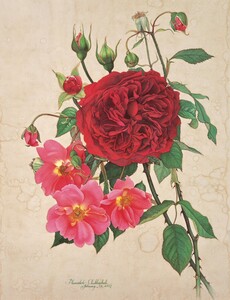
Botanical painting takes much more time to finish which I had to manage and find ways to paint botanical art from real life. In 2006 I started to paint many English Rose paintings from photographs for the magazine. I realized that I could still create dimensions and depth in my painting as the same as I paint from real life. My iPhone camera became my most important tool to capture anything, anywhere when I see the flower or the fruit that caught my eyes and immediately spark my intention of wanting to paint it at the first glance.
Do you take commissions?
I do not retake commission anymore. I have never accepted any request to paint the plant I have no inspiration or no desire to work on.
What is a very special story that happened to you because of your botanical art?
The very special story that happened to me because of my botanical art is the story about Dr Shirley Sherwood and I since the day we first met.
-5 artworks are in her book, ‘The Shirley Sherwood Collection Modern masterpieces of Botanical Art’
– She wrote about me and my artworks in her memoir, ‘SHIRLEY The Life of a Botanical Adventurer’.
Phansakdi Chakkaphak
Contact:
Website: phansakdi.c@gmail.com
Email: phansakdi.c@gmail.com
Interview by Deborah Blakeley, September 2026
Images on these pages are all rights reserved by Phansakdi Chakkaphak
Deborah Blakeley, Melbourne, Australia
Interview by Deborah Blakeley, September 2026
Images on these pages have all rights reserved by Phansakdi Chakkaphak

Think a colleague or friend could benefit from this interview?
Knowledge is one of the biggest assets in any business. So why not forward this on to your friends and colleagues so they too can start taking advantage of the insightful information the artist has given?
Other artists you may be interested in: