
Paul Cleden Printmaker / Illustrator
Discuss how figurative movement is so important to your work?
 Figurative movement has always been at the centre of my work, I have, from my earliest memories, been drawn to people and movement, the dynamic shapes and energy is mesmerising.
 The cutting process gives scope for long sweeping shapes, while the overlap of the multi block method increases this even more. As time has progressed, I’ve pushed things on, not wanting to get pigeonholed or to static with one “subject’ as its far too easy to do.
How does lino cutting give such natural flow lines in your work?

The images in circles, and in this case ‘Bike’, came from a specific need to create a series of circular prints for hanging decorations. It is always a delicious challenge to fit a square picture into a round shape. The removal of the square shape gave a freedom to experiment with slight distortion and composition. As ever I love a challenge.

Crowds can be both inside and outside compare two prints.
Crowds can be both inside and out. yet I feel a crowd is for the most gathered for something and in a space. For example, ‘Platform Talk’ has everyone restricted to the line on an underground platform, while ‘Theatreland’ has them arriving at the doors to a nights entertainment, but still restricted as they reach the entrance.
Everyone is restricted to the line on an underground platform, while ‘Theatreland’ has them arriving at the doors to a nights entertainment, but still restricted as they reach the entrance.
 Can you expand on your silk squares and how they can be used?
I was approached to use some of my designs on silk square, scarves and cushions, a few years ago now, which I’m always interested to do. I love to see my work translated onto other things, probably the illustrator in me. As to their success, that’s hard to judge, as I don’t sell them, they’ve ended up in some firstrate places such as Liberties in London, but my work on greetings cards has probably been the biggest success, I suspect the price point helps that.
 Your comment, “I have no problem with people buying this work as perhaps it is the only way to afford a specific image” Elaborate.
I love people to buy my original work as its the ideal way to enjoy it. Original prints are very affordable, but for some people the first step into owning original art is to buy something else. I have sold a great number of prints to people who initially buy cards, they get to live with an image without the initial cost, for many one of my prints is the first time they buy an original piece of artwork.

The only exception in my opinion, is a giclee, this does open Pandoras box, to spend good money on a posh photocopy when for a little bit more they can get the original seems a shame.
Discuss the ‘swing’ seen in Beat the Bat and Straight Down the Middle.
 ‘Beat the Bat’ & ‘Straight Down the Middle’ both part of a commission, each had a swing from the earliest drawings of cricketers, the motion that the figures created is clear when you see the game, which can be sedate for long parts, until the bowler takes aim, and the batsman responds.
 For that short time the frantic motion creates a fantastic swing. It arrived in the print from the very first drawings.
Take one city that you have illustrated and discuss the print.
I generally don’t do pictures of cities, as its the people I am drawn to, but in a recent commission for ’80 the Strand’ in London, the clients wanted three cities represented is a series of prints, London, New York and Manchester.

This gave me the opportunity to explore buildings. It is good to challenge oneself as an artist, in this case to find a language that sat with my work to show decidedly static buildings. In ‘Wet London’ I included rain and people rushing around to add movement with the backdrop of the London skyline, my hometown until I was 25.
 Tell us about your work from Purple Raincoat.
The images from the ‘Purple Raincoat’ is a very interesting one, as this is an as yet unpublished work, also written by yours truly. I have a considerable body of writing waiting like a fallow field to one day be harvested. I find that my illustration work is an ideal contrast to the prints I tend to focus on. Even here the backgrounds are prints, a freer mono print technique that allows for far more spontaneity and expression.

Perhaps one day ‘The Peculiar Purple Raincoat’ may be in a book form for everyone to enjoy. (any publishers do say hello!)
The process you take before the work goes to press.
The vast majority of my work uses four blocks of lino, so a base level of four colours, with the white of the paper as another factor.
 With each colour overlapping you can create another colour, so there is a potential of multiple variations, but then add in inking half a block with different colours and things gets interesting.
 Tell us about your studio.
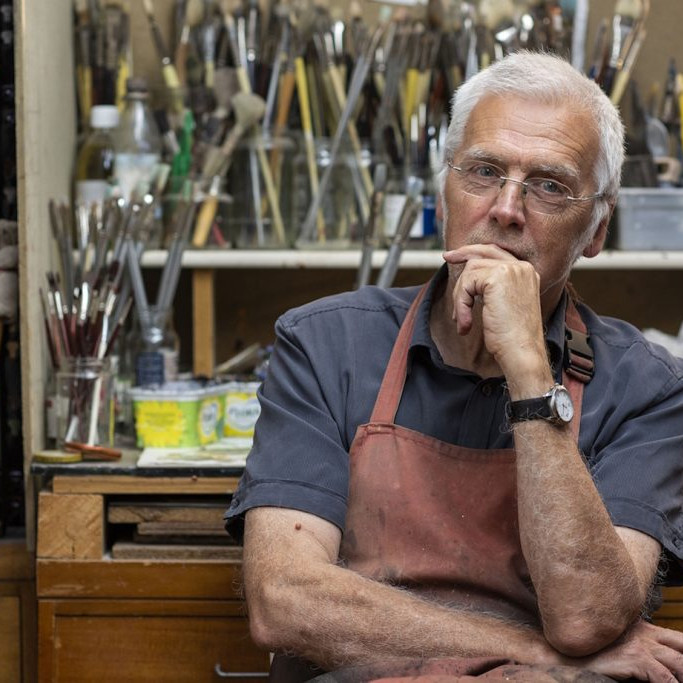
My current studio is only a year old, as we recently moved house and I had the garage converted last year. It’s a square white room full of light. The double aspect windows looking down the garden and off into the fields beyond. I do work alone here, which is definitely the hardest part of my job.
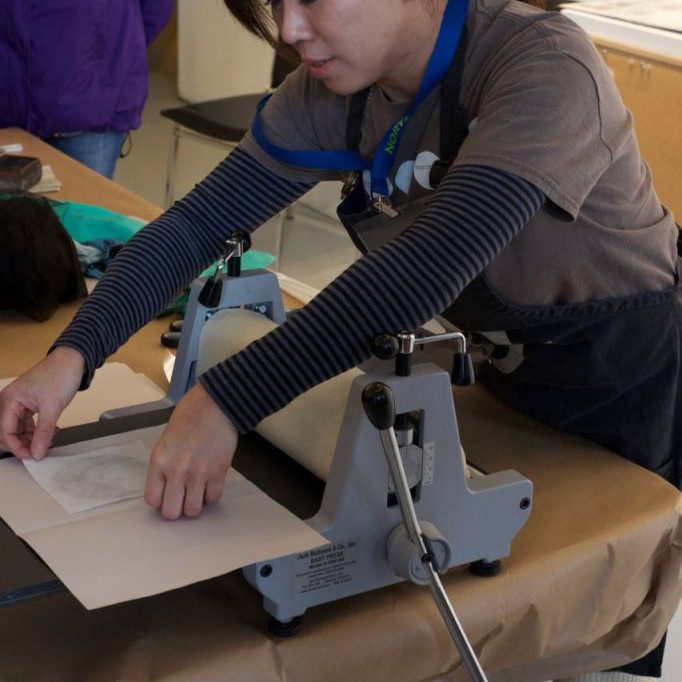
 I’m currently collaborating with the Leach pottery in Somerset on a set of work which celebrates their practice, ready for a show in July. This means I get to spend some time drawing in their pottery, with the company of the artists there. I use a wonderful 140-year-old nipping press, with a huge 60cm x 45cm bed, big enough for all of my work. To change anything about my studio? More storage, I suspect that most artists would feel the same as this. I do have a super garden room that I’m going to set up a screen-printing space in. On my ‘to do’ list for this year.

Contact:
Paul Cleden, Somerset, UK
www.paulcleden.com.uk
Mail@paulcleden
Deborah Blakeley, Melbourne, Australia
Interview by Deborah Blakeley, February 2026
Images on these pages are all rights reserved by Paul Cleden

Think a colleague or friend could benefit from this interview?
Knowledge is one of the biggest assets in any business. So why not forward this on to your friends and colleagues so they too can start taking advantage of the insightful information the artist has given?
Other artists you may be interested in: