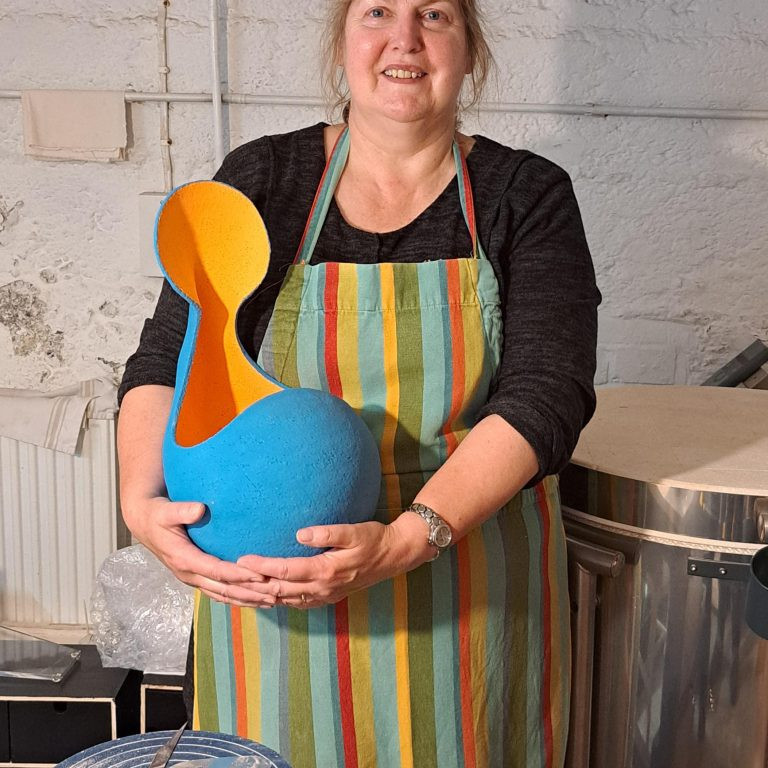
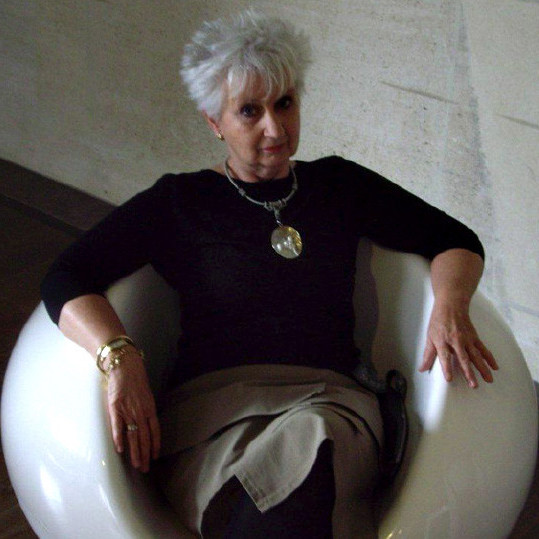

Nicole Farhi Sculptor
Do you feel that having formally being involved in fashion has made you very aware of body shape in your sculpture?
My years in fashion trained my eyes to read form, movement instinctive precision. That sensitivity to physicality carried over into sculpture. There is also a share discipline and emotional impact through shape. Both fashion and sculpture are for me acts of interpreting the body.
What are your thoughts on extending a hobby into a career?
Sculpting was more than a hobby for me. I always knew deep down that one day I will be sculpting full time. It took longer than I thought, because it is not easy to turn your back when you have built a successful company, and you are going to leave behind the people you have worked with and love, your team.
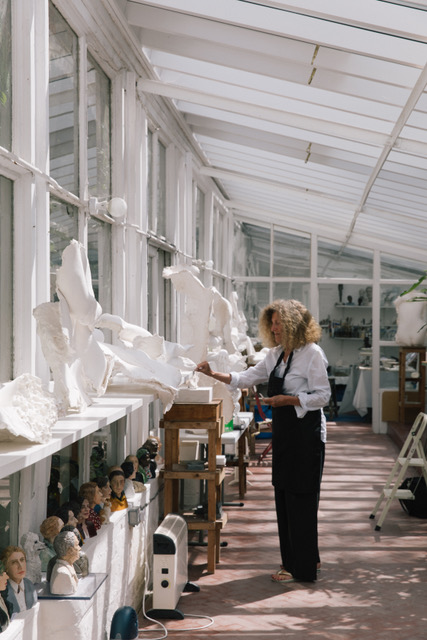
Nicole Farhi, Image by Iona Wolff
Why was your involvement with Eduardo Paolozzi so pivotal in your sculpture?
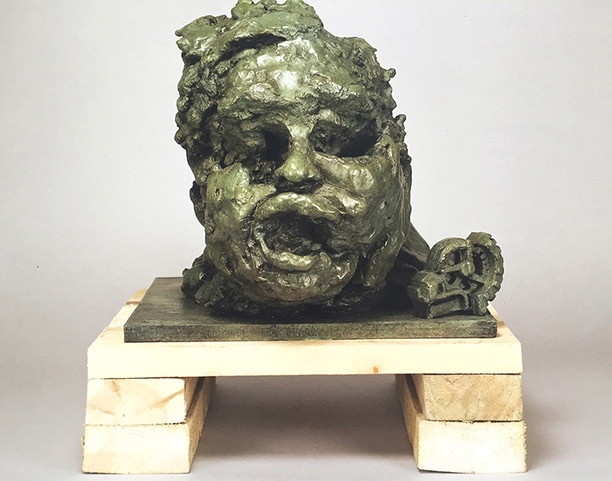 Homage to Eduardo Paolozzi #3
I met Eduardo Paolozzi in the late 80s at the Royal College of Art’s Foundry. I was casting my first bronze. Eduardo was taking some students around the foundry, he came and looked at what I was doing, was interested and invited me to his studio. He was extremely generous with his time and was always ready to look at the work of a young sculptor, he was ready to consider the work of any student and mine by extension as unique and therefore of value and interest. He would take me to his foundries, to museums, we will drive around London or would walk in the streets, and he would open my eyes to the world around us.
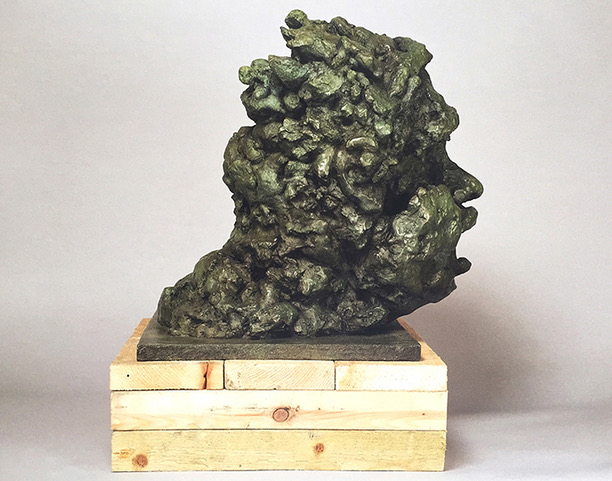 Homage to Eduardo Paolozzi #2
We became not only friends, but he became my mentor, he taught me to work in different mediums, plaster, wax. He gave me this invaluable gift, confidence in what I was doing.
Tell us about your exhibition J’Accuse….! and what you are focusing on.
J’Accuse… is a series of sculpted portraits of people who were wrongly accused and condemned for crimes they didn’t commit. Each face is a quiet remembrance of those who were silent, and it is about bringing them back into the present, not just as names in a file but as human beings with presence, dignity and story. In showing them, I hope to make space for reflection, it is our responsibility to remember. This exhibition at Pitzhanger Manor and Gallery has just finished but it will be shown again in Edinburgh during the French /Scottish Conference about Miscarriages of Justice this September at The Fine Arts Society Gallery 6 Dundas Street Edinburgh.
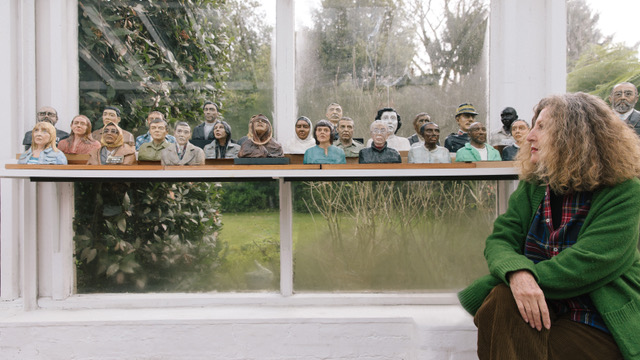
J’Accuse… image by Iona Wolff
Your sculptures range in sizes, take two on small and one large and discuss your choice of size and why?
The size of my work follows the emotional and conceptual focus.
When I sculpt a series of very small heads, it’s often about the many — a collective voice [Couples], a shared experience] Writers], or a common injustice [J’Accuse]. Each head is part of a chorus, and their smallness invites closeness and contemplation, almost like holding memory in your hand.
But when I sculpt a large bust of a single person [Paolozzi, Bacon, Giacometti…], the focus narrows to one human being. The scale grows because I want the viewer to feel the weight of that one life — its dignity, its suffering, its presence. It becomes monumental not just in size, but in emotional intensity.
How was your artistic career affected by Covid?
Apart from that fact I didn’t show my work for two years, and didn’t have any models coming to my studio. The two years of lockdown left me free to concentrate on my work. I enjoyed this forced solitude and worked well.
Discuss ‘Entrelace’ and why you use only some parts of the body.
In Entrelacé, part of the Womankind series, the decision to show only fragments of 2 female bodies—hands, legs, and feet entwined—speaks to a deeper intention beyond anatomical completeness. By omitting faces and torsos, I shift the viewer’s focus from identity and recognition to gesture, texture, and emotion. This fragment invites intimacy without intrusion. The entanglement of limbs suggests vulnerability, contemplation, and embrace.
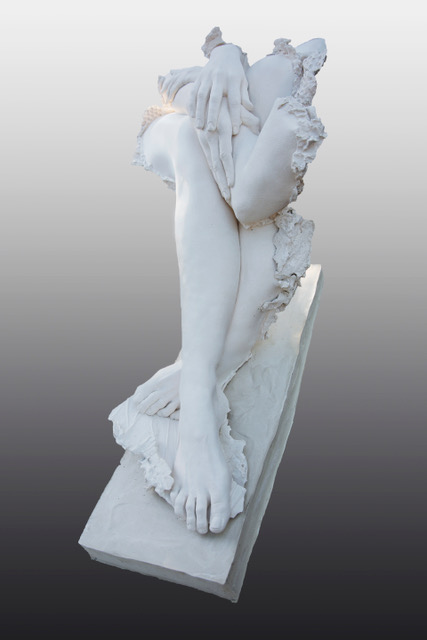
Entrelace
‘Couples’ comment on how you have added color to this collection.
I paint each series of little busts not only “Couples”. Perhaps because intimacy lives on the small scale. I am very fond of these little bust, they are like secret jewels made visible, their smallness invites closeness, I like finding details, in the case of “Couples” the shape of their dress, the color of their lipsticks, the color of their eyes, hair.; I enjoy spending that extra time with them.
Do you feel that being a woman, you are able more comfortable with work like ‘Cybele’?
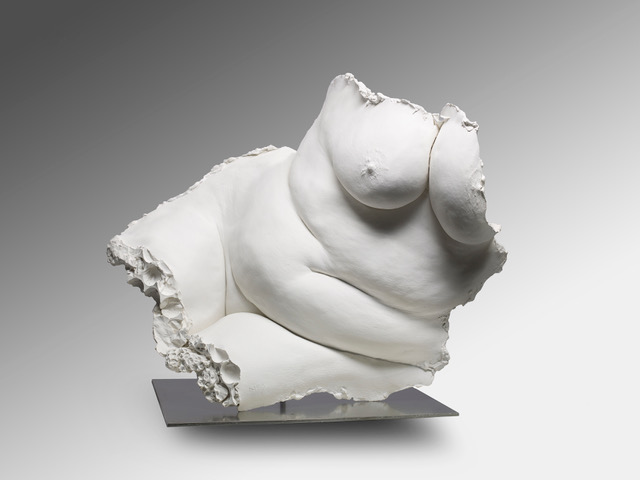
Cybele
As a woman, I carry an intimate, lived knowledge of how the body is looked at, judged, celebrated, or hidden. That embodied experience may give me a kind of truth-telling authority here — not just technical, but emotional. There’s a quiet defiance in Cybele, and maybe that comes from someone who knows what it means to inhabit flesh that is so often spoken for by others.
Whether I am more at ease because of my gender is not a question I asked myself; what matters is that I have chosen to speak from the inside out, and it resonates.
Would you say Cybele is a goddess of defiance as well as fertility
Yes definitely, Cybele refuses to shrink, to apologize. The folds of her flesh are not just maternal but sensual. She is full of energy; she offers life as power.
Comment on your ‘Jesomite’ Collection.
Do you mean Jesmonite. it is a water based acrylic composite material much lighter than traditional casting materials, it is easy to work with and reproduce fine details very well. I have been working with this medium which resembles plaster for a long time. Unlike cold, rigid materials like bronze or marble, Jesmonite has a natural soft matte finish and can feel almost skin-like. This tactile quality is perfect for sculpting moments when a woman is completely at home in her body. My new series” Intimacy” is a perfect example of what jesmonite can bring to my work.
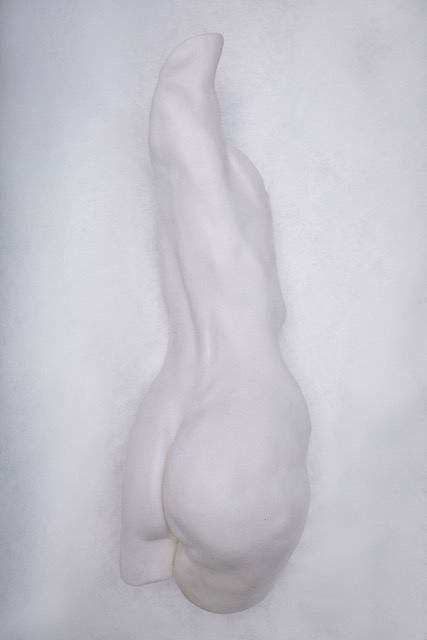
Intimacy
Expand on the importance of being able to add MRSS after you name.
I am not sure it has ever helped me so far. But I like to be part of the community of sculptors in the UK.
Expand on the technique of your sculpture. (briefly).
Two techniques.
1] I love modelling in clay and depending on the size of the work, I make a mold and cast the work in plaster or in cement in my studio.
2] Life casting. I make a mold directly on the parts of the model’s body I want to show. It is an intricate process; you have to work fast and very often it requires the help of an assistant.
Tactile and sensual are words that mark your sculpture, discuss.
My work is sensual and tactile because it is rooted in the body — both mine, as the maker, and the bodies I represent. I sculpt by touch, by feel, by presence. The act of shaping material is intimate: it requires closeness, attention, and care. I’m drawn to the textures of skin, the weight of flesh, the gravity of stillness after movement.
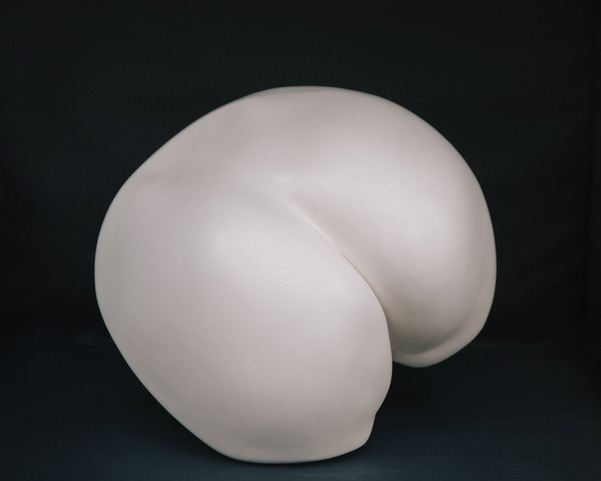 These are not abstract ideas for me — they are physical realities. I want viewers to feel something with their eyes, to sense the warmth, softness, or tension of the forms, even without touching them. Sensuality, for me, is not about seduction — it’s about truth. It’s about the honesty of a body at rest, unguarded, unposed, deeply itself.
What keeps you working?
I’m going to be 79 and I love working. I will never stop — because it’s who I am. Creating is not something I chose to do once — it is the way I live. It keeps me alive, present, and connected to the world. With every piece, I discover something new. As long as I breathe, I’ll keep making — because this work is not about age. It’s about life.
Each sculpture begins in silence and becomes a conversation between my hands, the material, and the body I am trying to understand. My work is sensual and tactile because that is how I know the world: through touch, through presence, through the physical truth of form.
I sculpt not to idealize the body, but to be honest about it — its weight, its softness, its stillness, its freedom. I am drawn to the moments just after movement, when the body is fully itself, unguarded. There is something deeply human in that quiet. Tactility is the language I use to express that intimacy.
Where do you get your models?
Asking friends, friends of friends, meeting by chance a lovely woman who accepts to sit for me.

Paolo Sitting, 2018, Plaster cast
Discuss the importance of your relationship with the foundry you use.
I work with two foundries: one for smaller pieces, one for larger works. The scale may change, but the care and precision remain constant. These relationships are as important to me as the clay itself. A foundry is not just a service — it is a partner in translation. They help carry the touch of my hands into bronze or other mediums without losing what matters: the softness of a curve, the tension of a line, the presence of breath in form.
Over the years, we have developed a shared language. They understand that my work is about feeling, not just finish. Their skill allows the sensuality and immediacy of the sculpture to survive the alchemy of casting. Without that trust — without that mutual respect — the work would not be what it is.
Where is your studio?
In my garden.
Take three sculptures that are historically important and why you wanted to sculpt them?
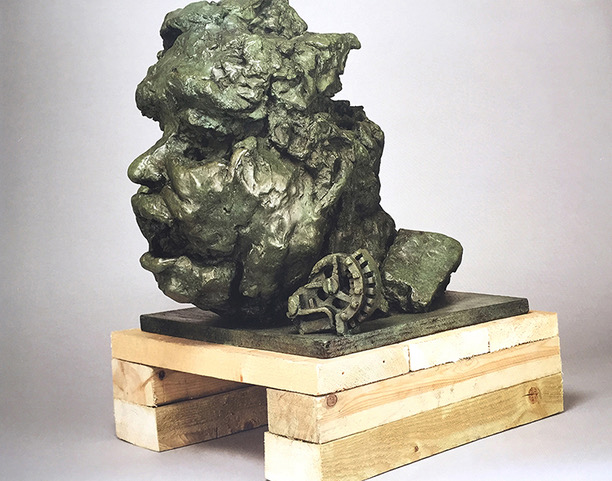
Homage to Eduardo Paolozzi . 1994/95 Bronze
I made his bust when Eduardo was alive. It’s raw, visceral, almost as if the form is resisting smoothness. His face here seems half-formed, or perhaps half-dissolved into the materials of his own imagination — Eduardo gave me his little mechanical form to play with, I added it at the base. The man and the machine in dialogue. it’s a sculptural memory of his volcanic mind. The exaggeration of flesh, the cavernous mouth, the suggestion of being overwhelmed — is this how I saw him in moments? Brilliant, prolific, but burdened?
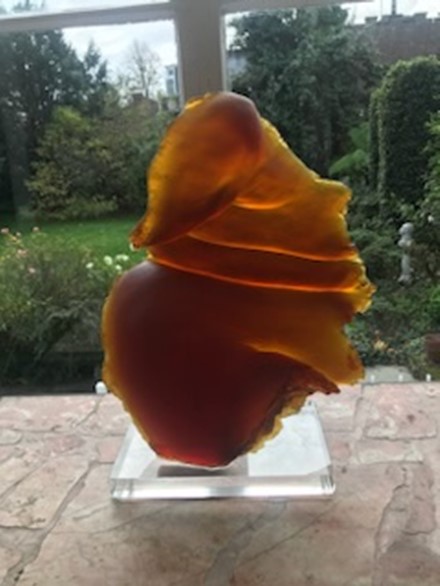
OPIS in Glass
The importance of trying new medium. Every medium gives you a different understanding of what you want to say/
— Glass carries an organic fluidity, almost like a wind-sculpted shell or a living flame paused in motion. The warm amber and red tones evoke both vitality and tenderness, with the translucency of the medium allowing light to animate it from within. Perfect medium to offer a dialogue between solidity and ephemerality.
REVERSO
Jesmonite, An important piece because a new departure in abstraction.
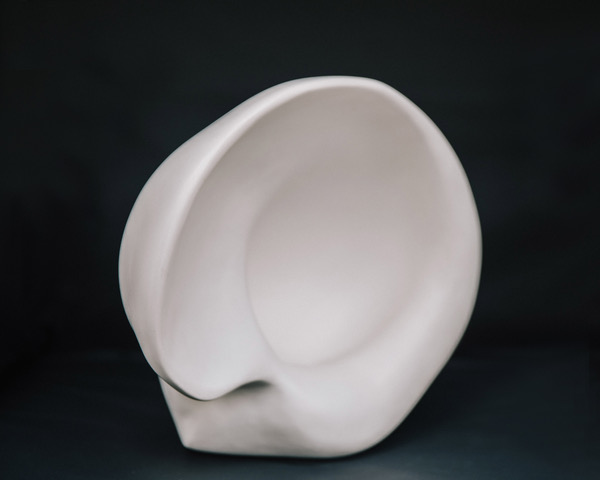
Reverso marks a turning point—a sculptural movement away from the literal body and into its memory, its echo. What once might have been the back of a seated figure becomes, in this abstraction, a site of pure intimacy: closed, enfolded, inward-looking.
The form suggests flesh yet refuses direct figuration. It is smooth, tender, almost shell-like—inviting the viewer not to look at it, but to feel with it. One side is convex, pressing outward like a breath held in tension; the other, concave, suggests retreat, protection, the inner curve of silence.
By withholding identity, Reverso becomes universal. It could be the back of a woman asleep, a seed, a gesture frozen in time. Its ambiguity is its strength. It speaks of bodies without showing them, of desire without performance, of rest without display.
Contact:
Nicole Farhi
Web – nicolefarhisculpture.com
Email – nicolefarhi1@gmail.com
Deborah Blakeley, Melbourne, August Australia
Interview by Deborah Blakeley, 2025
Images on these pages are all rights reserved by Nicole Farhi

Think a colleague or friend could benefit from this interview?
Knowledge is one of the biggest assets in any business. So why not forward this on to your friends and colleagues so they too can start taking advantage of the insightful information the artist has given?
Other artists you may be interested in: