Lucy Morris Sculpture / Ceramics
Can you Please expand on your comment, ‘My work is influenced by my role as a talk therapist?
Working with clients as a therapist has given me a strong awareness of how emotions and psychological states shape human experience, and I translate those insights into material form. Clay becomes a medium through which ideas such as vulnerability, resilience, and repair can be explored in a tangible way.

Becoming from within.
What has been your art training?
I started using clay in an evening class when I was fourteen and I fell in love with the material. This led me to using clay in my GCSE’s, A levels, and then starting to specialise in my foundation year at Hereford Art College. From here I completed a Bachelor of Arts degree in Ceramics at Cardiff university, which I completed in 2004.
What has been you talk therapy training?
I started using clay in an evening class when I was fourteen and I fell in love with the material. This led me to using clay in my GCSE’s, A levels, and then starting to specialise in my foundation year at Hereford Art College. From here I completed a Bachelor of Arts degree in Ceramics at Cardiff university, which I completed in 2004.
Discuss the importance of the large ears of a hare?
The extended ears in my work speak to the quiet power of listening, a central element in my therapeutic practice. In the therapy room, I often witness how rarely people feel truly heard. This absence isn’t always loud; it can show up in the subtle, repeated missing of someone’s emotional needs. Many grow up in environments where they feel unseen and unheard, and this emotional invisibility can deeply impact wellbeing. The ears in my sculptures aim to hold that story. They carry feeling, elegance, and the ache of wanting to be noticed, not just visually, but emotionally.
 Enough
Why have you introduced small touches of colour to your hares?
I have always loved colour and I enjoy the placement of this on the work to draw attention to specific areas. Colour can hold a lot of emotion and I have always found myself drawn to blues. My aim in future work is to explore the use of colour and surface further.
Comment briefly on the process of hand building your ceramic art?
Each piece is initially made from solid clay shapes that I roll and shape. Once I am satisfied with the direction of the piece and the proportions work, I start to sculpt the more detailed parts which are the face and paws.
I spend quite a lot of time ensuring the face expression matches important. The piece is then dismembered, and the shapes are hollowed out before I reassemble to piece.
The hollowing process is carefully considered as with many pieces I need more weight to hold the sculpture in its sitting position safely, yet the feet and legs need to be less heavy. Decisions are made as I move through the process.
What I am aiming for. and that the paws are the right size for what I have imagined.
Where is your studio?
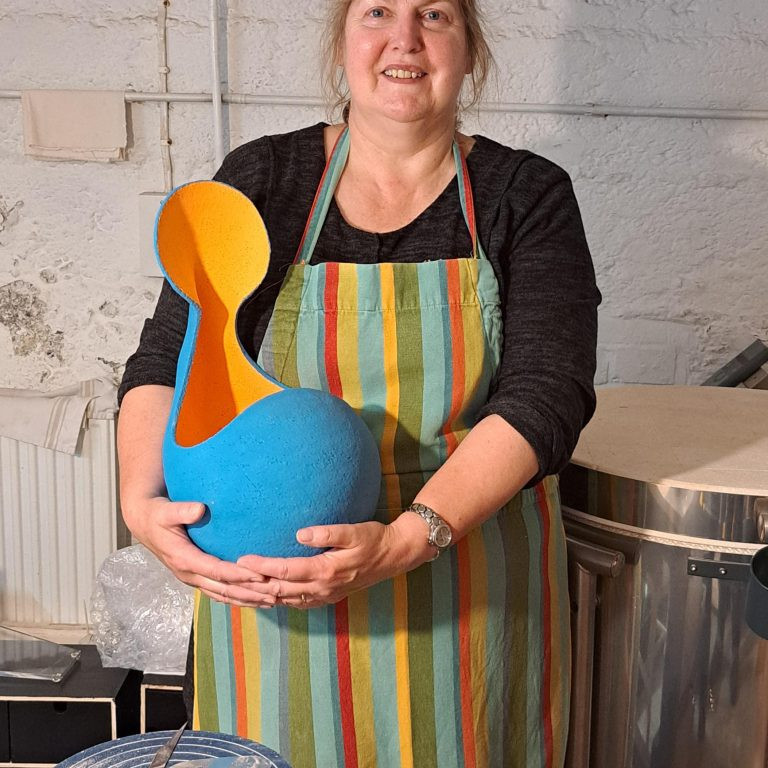
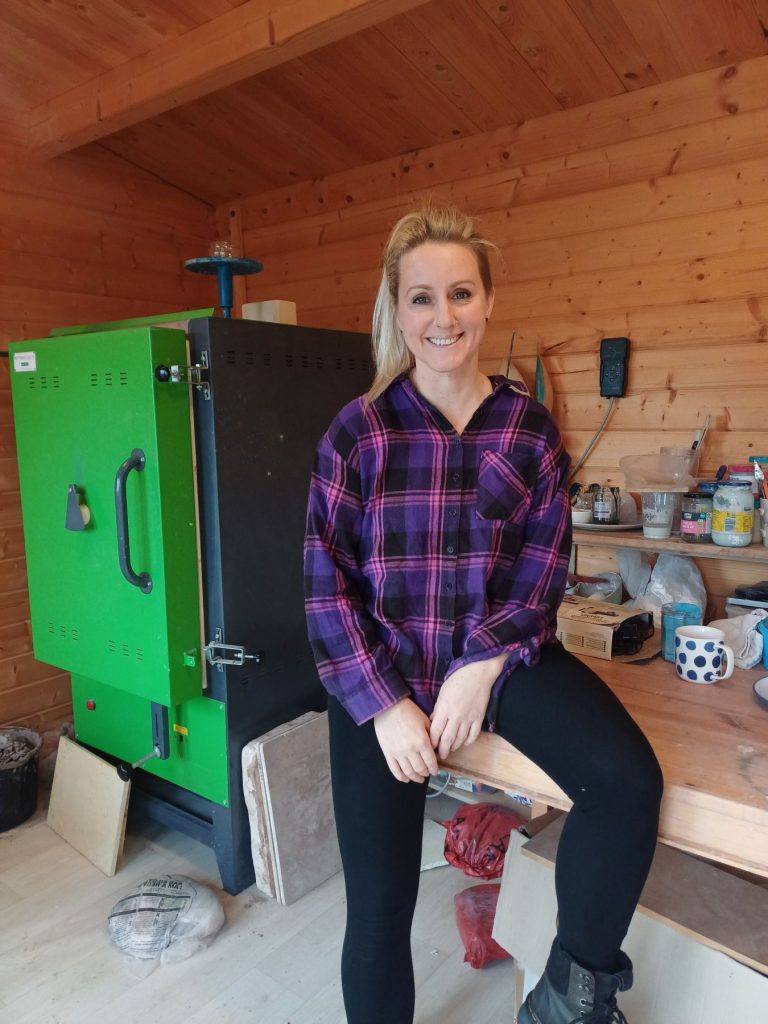
I work from a summer house which is in my garden. It gets very cold In the winter months, so sometimes the work moves into the house temporarily.
Are you completely self-sufficient?
Yes, I work independently.
How do you personally look after your own mental health?
I enjoy exercising and spend much of my spare time downhill mountain biking. The combination of being in beautiful forests or mountains and trails feels very cathartic and mindful. It is almost impossible to think about anything other than what I am doing right there in that moment. I also enjoy trail running, weightlifting and I ride a motorbike. These activities offer a counterbalance to the stillness of therapeutic work and the gentle physicality of sculpting.
How do you manage to get such human expressions on your hares faces and body language?
I think this aspect of my work has grown from hours spent observing clients in therapy, attuning to the body’s unspoken language. As a therapist, we are trained to listen beyond words and that the body holds a narrative, often revealing what cannot yet be voiced. This embodied awareness informs both my clinical and sculptural practice.
Do you often see the likeness of hares to young children?
For me, my work is rooted in the adult experience, reflecting the relational dynamics I encounter in therapy and throughout life. While that’s my starting point, I think the beauty of art is that people make links and connections that feel personal to their own experience, so I always enjoy hearing the perspective of others.
You do two sizes of hares, why?
My work has a range of sizes from miniature pieces you can hold in your hand, to much larger sculptures.
There is something that can feel very intimate about holding the smaller objects and I notice they often create a real depth of emotion. Its not uncommon for people to cry or have strong reactions when they are held.
The mid and larger pieces hold more of a physical presence. I enjoy the physical process of making larger pieces and have always been drawn to the idea of making larger sculptures. If I had a bigger kiln I’m sure the size would keep expanding.
How many real hares are within your environment?
I find this question interesting because for me my fascination with hares began whilst I was teaching ceramics in a prison environment rather than because I grew up seeing many, which often surprises people.
In the prison we started an animal project which focussed on Hares as they represent both hypervigilance and vulnerability; something which we explored as this mirrors parts of the prison experience. In my work the use of the hare is more symbolic to this, rather than because I have grown up sighting them.
 Honour your experience
Living in South Wales I have unfortunately not been lucky enough to see a hare near to my home, however, with summer trips to mid and north Wales I have been spolit with some sightings.
Comment on how are your hares designed to sit on plinths or shelves?
The weight of the body and limbs support the expression of emotion that I want to capture.

Hanging on to the edge of life
One of the first pieces I made in this style was inspired by observing people sat outside one of the homeless shelters I regularly visited for a previous job. I would notice the weight of people’s bodies fallen against walls. There was a sense of heaviness, not only of the physical body but also the emotions and trauma these people were holding.
I wanted to find different ways to place my pieces in expressive postures. I found always working to a flat base was limiting. For example, a recent piece called ‘Hanging on the edge of life’ was inspired by clients descriptions of anxiety, where there is a sense of falling and slipping off. At times I like to use gentle humour to express challenging emotions.
I often imagine the hares sitting, reaching for connection, slumping, or falling. The long shelves and plinths have enabled me to create work that can be viewed from the perspective that I imagine it.
Take two hares with different attitudes and discuss.

She let go and her breath came back
At its foundation, this piece is about hope and survival. It is about moving forward.
I wanted to express something about how we hold trauma physically. The heavy weight of the limbs and body giving a sense of what has come before. The legs and thighs are exaggerated and powerful, suggesting that there is strength within and there is an innate ability to move forward and survive.

This Too Shall Pass
This piece carries a thoughtful tension which is captured by the gaze of the eye and body positioning. Inspired from my client work in the therapy room, there is a sense that something quite serious is being considered or is in the process of being worked through.
Discuss, ‘Fall Seven Times and Stand Up Eight’ and the titles of each piece.

Fall seven times and stand up eight
This piece was made for competition where they asked people to make a piece inspired by a famous quote or saying. I chose this saying because for me it represents something about survival and moving forwards despite the adversity that we may experience in life.
The titles of the sculptures have developed to be a powerful part of the work.
When creating a new piece, I start with the emotion or the feeling that I want to express. This is often inspired by an encounter in a therapy session or a thought or feeling I have about my own life experiences. I spend time considering how I can best portray what I am considering. Once created the naming process is there to support what came before.
Do you take commissions?
I have made some commissions. However, I notice that sometimes this process can deviate slightly from the creative aspect as there are by nature more rules about what the outcome will look like.
Do you find yourself falling in love with each hare as your hands bring them to life?
Yes, absolutely. I particularly enjoy creating new larger pieces or when I am in the process of sculpting the posture and expression for the work. It often becomes an intense hyper focus, and I am lost in my studio for many hours at a time.
How many exhibitions can you manage in a year?
I am just nearing the end of my second year of exhibiting, I think I am still finding my feet with balancing my therapy business and art work. Last year I exhibited in four shows and this year I have exhibited in six. This felt like quite a lot as I have also set up my private therapy practice this year.
What are your plans for 2026?
Now I am having a little creative breathing space after a very busy year. I am in the middle of the ‘thinking stage’ where I consciously daydream and piece ideas together in my mind. I cannot say exactly where next year will take me, but I do know I am excited to progress my work. I have started the application process to some of the shows so I am hopeful that I will be successful
Contact
Lucy Morris
lucymorrisceramicart@gmail.com
Deborah Blakeley, Melbourne, Australia
Interview by Deborah Blakeley, December 2025
Images on these pages are all rights reserved by Lucy Morris

Think a colleague or friend could benefit from this interview?
Knowledge is one of the biggest assets in any business. So why not forward this on to your friends and colleagues so they too can start taking advantage of the insightful information the artist has given?
Other artists you may be interested in: