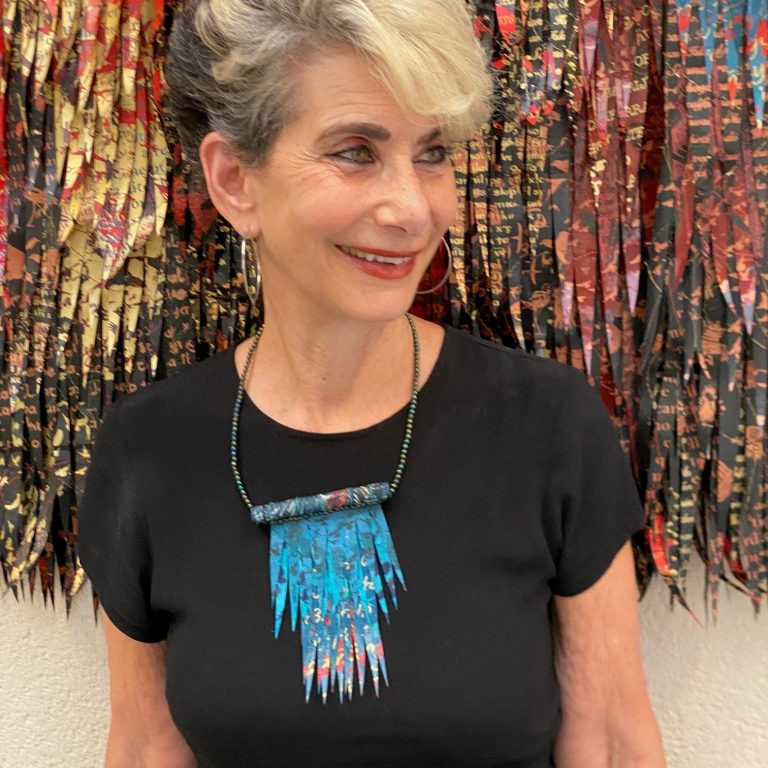
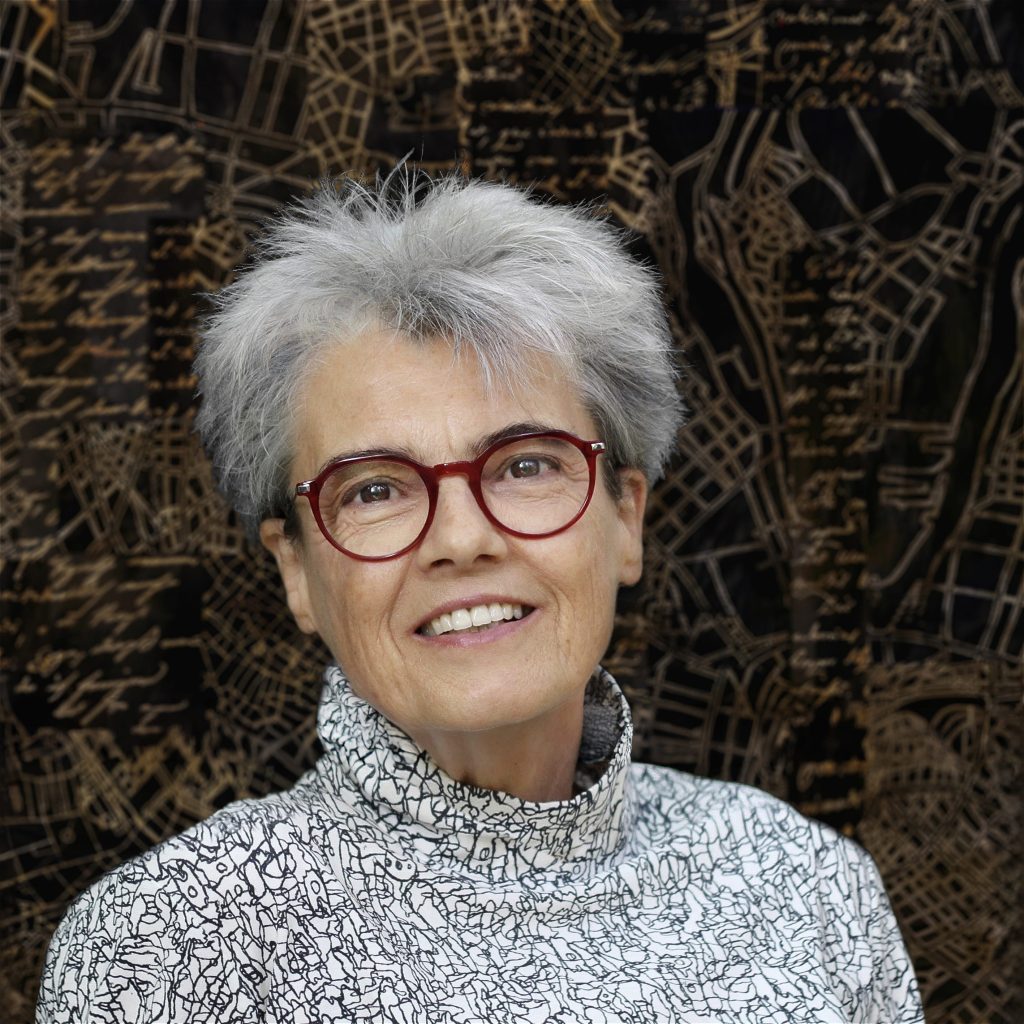
Eszter Bornemisza Textile Artist
Does your mathematical work transfer to the grids in your artwork?
I don’t think so. The grids are simply the easiest structures for holding small pieces of paper together. They also remind me of the old paper maps, which were divided into smaller squares by a grid, and you had to find a particular street within a cell, say F5. It is hard to believe now how difficult it was to find an address using those maps with all the street names written in such tiny letters.
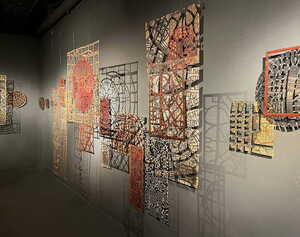
There Was a Point 210 x 1900 x 45cm, Cut out painted, overprinted newsprint, threads
When did you leave art quilting and begin to create transparent wall hangings?
I didn’t leave quilting at all; I still do both. In fact, making transparent wall hangings has helped me develop my quilting technique and style.
Where do you get your base materials and dyes from?
Recently I’ve been using mainly discarded or old materials, I only buy paints and dyes occasionally that are available in ordinary art supply shops in Budapest.
Apart from wall hangings you also transfer your art in 3D pieces – discuss.
As I had collected a lot of newsprint, I started making paper pulp from it and casting it onto various armatures, such as cardboard, chicken wire, or stiffened textiles. Then I found that cooking paper pulp from different grass-like plants gives the dried surface a more interesting texture, so I started experimenting with different species of rush and sedge.
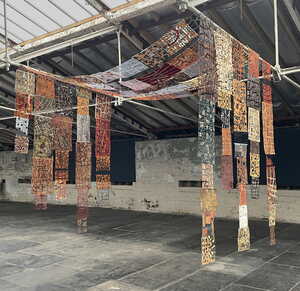
Delve and Discover 240 x 170 x 150cm, 2024, Cut out painted, overprint, X-ray films, transparencies, felt, tissue, threads
The shape of my 3D works often develop from pieces of cardboard or chicken wire left over from earlier projects, or from scraps of worn stockings with holes that I stiffen. I try assembling these materials in different ways until the shape starts to resemble something I can associate with recurring issues around me.
An example is Dummy (21 × 43 × 32 cm, 2020). It is about manipulation and control. The figure speaks, but the arm behind it shapes the content. Nothing of its speech is its own — the words, the timing, and even the gestures come from someone else.
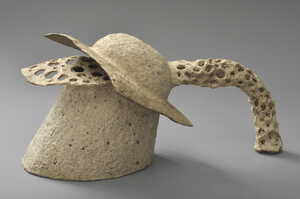
Dummy, 21 x 43 x 32cm, 2020, Cardboard, stiffened textile, paper pulp of rush and sedge
How do you develop colour into your current work?
I mainly work with muted earth colours. I use mineral pigments, some of which I collected myself, as well as transparent inks and dyes. I mix and test them until I’m happy with the result.
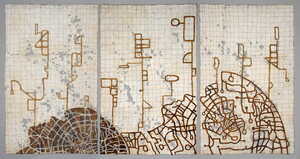
Mapping Unseen Territories, 103 x 195cm, 2021, Haji paper, cutout overprint newsprinted
Comment on the influence of old and new maps on your work?
I really like the graphical language of maps. They tell us so much about how a society was organized and how it adapted to its geographical circumstances. There are so many variations between the extremes of chaotic and clearly organized settlements.
But these labels are also relative. A map may look chaotic to us but be completely familiar and natural to the people who live there. People who are used to a chaotic street system might not feel comfortable in a city with a strict grid-like layout.
I choose maps that somehow support the idea I am working on. I often distort, fragment and layer them to make them fit the work.
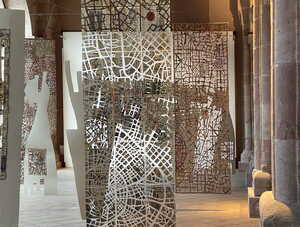
The City Within, 300 x 1500 x 1200, Cardboard, cutout painted, overprinted newsprint, threads
Discuss ‘place’ in your art.
Place, for me, doesn’t only mean a physical location, but also a position in society and a mental state. Ten years ago, I made a large installation titled You Are Here (180 x 320 x 30 cm, 2016), with lots of partly overlapping translucent city maps and a hidden red dot.
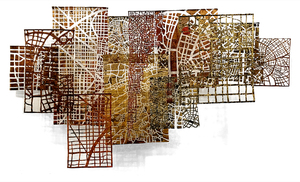
You are Here, 180 x 320 x 30cm, 2016
Some years later, when I saw it exhibited again, I suddenly realized that it wasn’t only about orientation and getting lost, but also about finding my own way as I as striving to become an artist. Coming to art without formal training, I needed a long time to gain confidence and find my place in the art world.
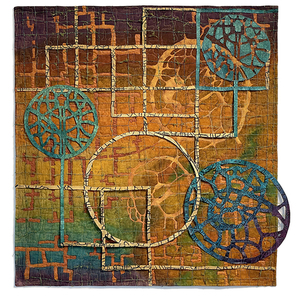 Emerging Structures, 84 x 84cm, 2023, cotton quilt, cut-out painted, overprinted newsprint, threads
What or who helped you become a fiber artist?
I have always been making things. From my early teens, I was sewing clothes, weaving, making shoes and painting shawls, but these were just hobbies for many years. Meanwhile, I trained and worked as a mathematician and had a family with children, and all these earlier activities became useful practices later on.
Then, in 1996, I had the chance to visit a Quilt Expo in Lyon, France, where I saw modern art quilts for the first time. It was a great Aha moment for me. I suddenly realized that this was the kind of thing I wanted to do, and not just as a hobby.
I even made a secret, rather bold decision that one of my pieces would be exhibited at the next Expo — and eventually, it happened.
Discuss the positive and negative aspects of your art.
I’m not sure I would describe them as positive and negative aspects, but there are certainly strengths and challenges in my work. I really love being in the flow of doing my thing, starting with smaller or larger scraps or fragments left over from earlier projects, shaping and adding to them, and developing ideas through free association as the piece itself takes shape. I also often remake my own pieces, sometimes years later, when I get a new idea. The challenges start when I try to find venues to exhibit them, as there are relatively few galleries showing fiber art.
How has modern technology effected, how you understand maps and location?
Modern technology has made finding our way much easier. We can see exactly where we are and where we need to go, without necessarily having to understand the map itself.
But I think we still have our own inner maps. Our sense of a place is shaped by memories, experiences and associations, and these can be very different from the precise maps we see on our screens. We may remember a place through a particular street, a view, a smell or an experience rather than through its actual geographical position.
For me, this difference between the precise external map and the much more personal inner map is intriguing. My maps are often somewhere between the two: they start from real places, but become fragmented, layered and reshaped by memory and association. Some of these ideas took shape in the large installation
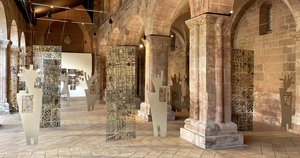
The City Within (300 × 1500 × 1200 cm, 2022), created for an invitation to exhibit at Galerie Alspach in Kaysersberg, Alsace, France.
How fragile is your work?
They are fragile, but with careful packaging, they can be rolled up and shipped quite easily.
What are you trying to show the viewer through your work?
I don’t think I’m trying to show the viewer one particular thing. I usually start with a very raw idea or a question that interests me, and let the work develop through experimentation. My starting points are often fragments left over from earlier pieces, alongside new elements that I create specifically for the given piece. The work develops through the process and can take me somewhere I didn’t expect. I hope that the finished piece leaves enough room for the viewer to make their own connections and associations. What they see in it may be quite different from what I had in mind.
Do you take workshops?
No. I like to learn through my own experiences, trials and failures. I’m not keen on following instructions or trying to be creative when I’m not in the mood. I like to be driven by my curiosity and imagination and to find the right techniques to follow them. Failures and mistakes may lead to new ideas, which bring new technical challenges, and so on in an ongoing cycle.
When I started making art quilts, I quickly realized that although I already had technical skills, I still needed to learn to think visually. I began systematically studying books on modern and contemporary art, as well as exhibition and museum collection catalogues that we had at home. I tried to understand and put into words why certain artworks drew me in while others, although equally accomplished, did not. For years, I made a habit of returning to my favorite books, looking at them again and again. Over time, I noticed that my responses to the same artworks had subtly changed. I realized that I had obviously learned something.
How far and wide has your work taken you?
Quite far and wide. I have travelled with my work for exhibitions and solo shows in the US, China, Australia, the UAE, the UK, France, the Netherlands, Spain, Germany, Italy, Austria, Switzerland, Luxembourg, Denmark and Russia.
My work has also been exhibited in places I haven’t visited myself, including Bolivia, Brazil, Uruguay, Mexico, Japan and Taiwan. So in some ways, my work has travelled further than I have.
How do you store your materials? How do you catalogue your materials?
They are rolled up and stored on shelves, and I keep a list of them on my computer in chronological order. The materials themselves are not catalogued. I usually find them by memory, although that often fails.
Tell us about your studio.
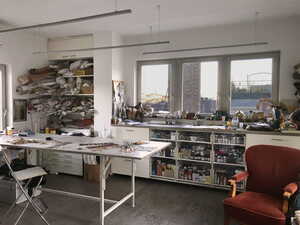
Originally, I started working on the dining table, as many fellow makers do. Then I had a small studio in our apartment, partly under the staircase. For the last ten years, as all three of our children have moved out, I’ve been able to take over a large room and turn it into a nice, spacious studio with a big design wall.
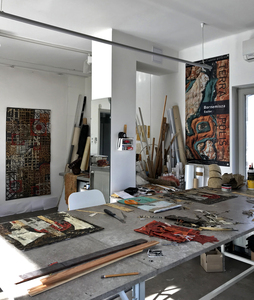
Plus, one feature you love and one you would like to have.
I love my spacious studio. I wouldn’t mind having a slightly higher ceiling, though.
Contact: Eszter Bornemisza
Website: https://bornemisza.com/
Email: Eszter@bornemisza.com
Interview by Deborah Blakeley, October, 2026
Images on these pages are all rights reserved by Eszter Bornemisza

Think a colleague or friend could benefit from this interview?
Knowledge is one of the biggest assets in any business. So why not forward this on to your friends and colleagues so they too can start taking advantage of the insightful information the artist has given?
Other artists you may be interested in: