Alan Stones Painter, Printsmaker
You realized your dream. Discuss – What an amazing thing it is to achieve being a full time artist and for a lifetime
As ‘being an artist’ is what I do every day I don’t usually think of it as amazing. I do, though, think of it as a huge challenge. . each day!
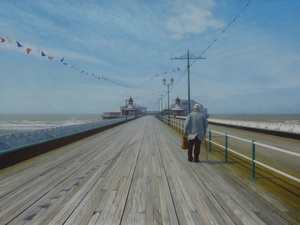
‘Fun’ 2020 oil on linen 1070x1420mm
Towards the end of my four years at art college all the students were advised to ‘do a teacher training course which will give you something to fall back on’. That phrase of ‘something to fall back on’ was an anathema to me. It seemed to me that if there was something to fall back on then ‘fall back’ is exactly what we’d do.
Two qualities that have carried me along are a relentlessness and also optimism but these have been coupled with my great fortune in having had a lifetime of good health.
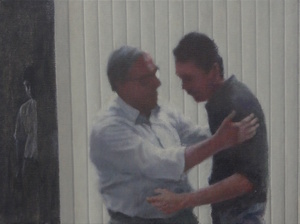
‘Father and Son’ 2015 oil on linen 459 x 610mm
I have also been fortunate that so much of my work has been appreciated and bought. Each time one is bought. I am surprised and it feels like a minor miracle.
How can you link your work with your insight into LS Lowry’s work?
As a child I was aware of the paintings of LS Lowry. He worked close to where my granny lived. I believe she had once met him and the local press would feature him. In the 1950s printed reproductions of paintings wouldn’t have been that great but perhaps they didn’t need to be for Lowry’s essence to work on you.
It wasn’t until I was in my 50s that I realized that there was a similarity between Lowry’s paintings and my approach to some of my subjects – a sort of monochromatic dourness or gloom emanating from smog ridden Manchester and Salford in the 1950s.
I have made paintings which, as with Lowry, include groups of anonymous people. For example, ‘Immediate Family’, which depicts 20 figures, their backs to us, standing together and silently grieving the loss of family members in an unspecified disaster.
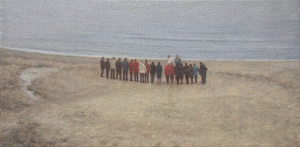
‘Immediate Family’ 2007 oil on linen 254x506mm
Expand on your work of hill farming in the North Pennines
In 1982 I moved house from Norfolk to live in a remote hamlet in east Cumbria. 44 years on I am still there though the village no longer feels so remote.
Pretty much straight away I won an Artist in Industry Award to work in a bakery in Doncaster. So back south I went. The bakery had 200 employees and I chose to draw them at their individual work. The board room was my bedroom but, being a bakery, the workforce would turn up for work at 4.30am and so my day started then.
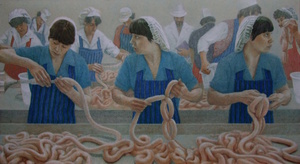
‘Sandra’ 1983 Cooplands Bakery oil on linen 500 x 900 mm
I’m mentioning this residency because it came as a surprise to me that restricting my choices of subject and looking only at people at work was something of a release for me. I produced more work. So, when the bakery residency was behind me and I was back in Cumbria I imposed a similar artist in industry theme on myself and decided to look at, what was surrounding me in my hamlet – hill farming.
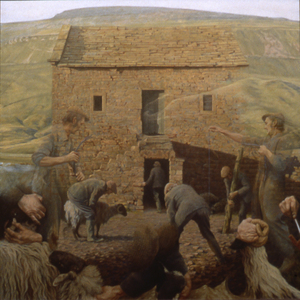
‘Jarrod and the Bastle House’ 1988 oil on linen 1020 x 1020mm
In the village there were several farms but one of them had Jarrod working on it. He was totally uninhibited by my presence and, it seemed to me, that everything he did, every job he put his hand too, just looked so wonderful.
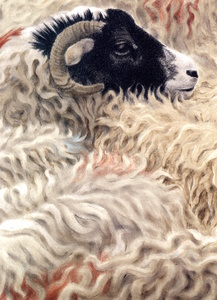
‘Swaledale’ 1984 plate lithograph 410 x 300 mm
In retrospect I can see that I was kidding myself about the supposed restriction of the theme ‘hill farming’. Yes, there was Jarrod at work but there was also the glorious landscape of the Northern Pennines, and as well as farm buildings and machinery there was also the sheep!
‘Hill Farming’ as a theme stayed with me for about 9 years, until I decided that the restrained and timid sheep was my alter ego.
What has led you to work in both paint and print?
At art school (St Martin’s, London 1967 – 71) I enjoyed drawing and painting but not printmaking. I just didn’t engage with it but then later, in 1984 and 13 years into my career, things changed.
The Gulbenkian Foundation were offering six awards to painters and sculptors to experiment with printmaking. I was fortunate (and astonished!) to win one of these.
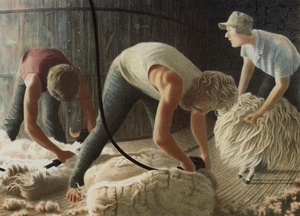
Shearers, 1985, plate lithograph 450x 620mm, Gulbenkian Foundation commission
At the time there were two print workshops in the North of England and at one of these, Lowick House, there were caravans enabling you to stay cheaply for weeks on end and, if you wanted, to work around the clock.
The graphite drawings I was making at the time (on the theme of Hill Farming) seemed to suggest to master printer John Sutcliffe, that lithography would suit me. I was working long hours every day making 7 or 8 colour lithographs and editioning most of them to 200. Making lithographs with John was thrilling, but it was also scary. When you’ve printed 200 prints in 6 colours and then, late at night, you decide to add a vibrant red. . it’s nerve wracking! You might make the print look great, or if your judgement is awry . . it’s a complete failure.
Drawing for a lithograph would normally be done with a black greasy crayon or black ink but the printing would be done in colour.
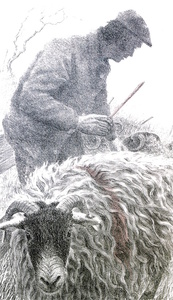
‘Marking’ 1986 stone lithograph 460 x 270 mm
Printing the colours separately and watching the print come together with layer upon layer of colour has taught me an enormous amount about colour and colour temperature. This understanding has, in turn, hugely informed all the paintings I have made since.
When Lowick House Print Workshop closed in the late 1990’s I drove over to North Tyneside Print Workshop to make prints, but loading and unloading the car with materials and driving each way took up about 5 hours of my day. This became untenable; but then good fortune came along and, in the year 2000, I was awarded a European Union Cultural Business Venture Grant to help build my own print workshop!
These print sales have taken a lot of the strain when it comes to earning a living and they’ve enabled me to make the paintings I want to make, even if I’m taking several months over some of them.
Show us how you use minimalism in your work
In 1996, when my partner was away visiting her relatives in New Zealand, I returned to Lowick House Print Workshop to make a print of a couple of old and gnarled hawthorn trees on a hillside. I began by trying, and failing, to print a green textured ground for the hillside.
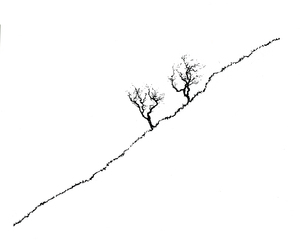
Couple’ 1996 plate lithograph 405 x 500 mm
I couldn’t get it right so I went out for a long walk to rid myself of the frustration. Just as I arrived back at the workshop I realized that I wasn’t particularly interested in the texture of the ground. My priority was the relationship of the two trees with the line of the hillside that they were clinging to. The ground of the hillside was deleted from the drawing and the first of my ‘minimal’ prints, ‘Couple’, was born.
At some level, the two trees next to each other, but not leaning against each other, represented myself and my partner. Also, I think that the vast open emptiness of the South Atlantic had perhaps opened me up to embracing space in my prints.
After ‘Couple’ I made many more such prints. It seemed to me that the more I left out, the stronger the image became. At first the majority of these prints depicted trees and birds. I was now embracing the more attractive idea of ravens as a wilder and freer alter ego than sheep!
Eventually I began to wonder what would happen if I were to draw people directly as opposed to things standing for/representing people and to my delight, my walking/climbing figures with their burdens (ruck sack) on their backs continued to allow for metaphorical interpretations of people and their endevors.
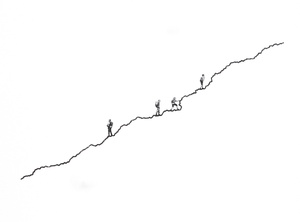
‘Climb (vii)’ 2018 plate lithograph 316 x 400 mm
In 1995 I was invited, by the Governor of the Falkland Islands, to work on the islands for three months and ‘give the islanders a view of themselves from the outside’. Much of the economy of the islands is based on sheep farming and the Governor, whilst in Cumbria, had come across a set of my farming lithographs in a restaurant here.
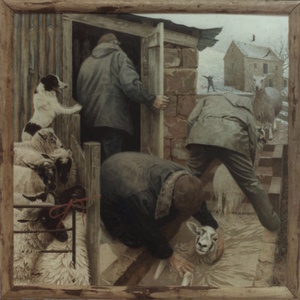
Scab, 1984 oil on linen 1140x 1140mm
Comment about the importance of people in your work
I can enjoy looking at paintings which don’t include people but successful paintings that do include them invariably feel, to me, like a more satisfying encounter. I’m more engaged by them and my experience is potentially greater.
Certainly, with my own paintings I am more entertained by them if, whilst making them, I can tap into aspects of myself – if the paintings touch on real or imagined experience. They are likely to do this if I can sense something psychological going on, or just the suggestion of a narrative or even humor.
My painting ‘Hotel du Monde’ (147 x 198 cm) has been simmering away for several years and over that time I have made a good many study of various sizes for it.
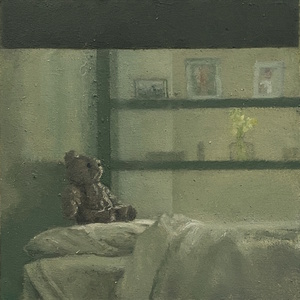
‘Hotel du Monde’ study-room 312 2026 oil on board 140x140mm
A recent solo landscape exhibition meant I had to put the painting on hold, but I am determined that it will be completed this year.
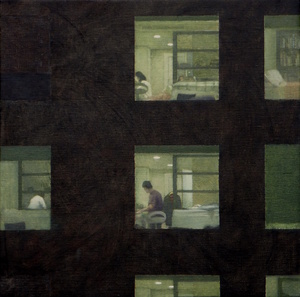
‘Hotel du Monde study (ii) 2024 oil on linen 500x500mm
Essentially, it’s a painting of a view from ‘our’ (the observers of the painting) window at night which looks out onto the façade of another building. To the side of ‘our’ window, inside ‘our’ room a digital clock reading ’20-26’ is reflected in what must be ‘our’ mirror. The building we can see through ’our’ window has similar windows to ours and we can see 36 of them.
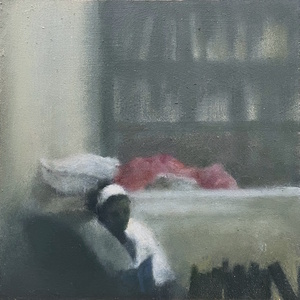
‘Hotel du Monde’ study for Room 112, 2026 140x140mm
These windows have blinds – some open, some partly open, some closed and some of the rooms have the lights on . . which means we occasionally get a glimpse of an occupant. These rooms might be cells; they might be hotel rooms; they might be homes. In this larger painting we wont see more than one occupant. The painting is still in progress but, I’m hoping that, when finished it will carry my wonder – a curiosity with and an awe at the lives of others.
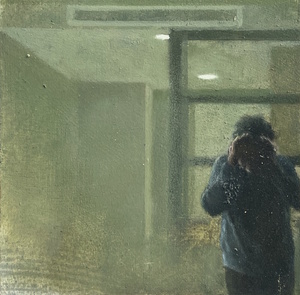
‘Hotel du Monde’ study-Room 306 2026 oil on board 140x140mm
The photograph of this painting shows it on my easel with photographs of smaller studies attached. These are there just so that I can get a better idea of how everything might eventually look.
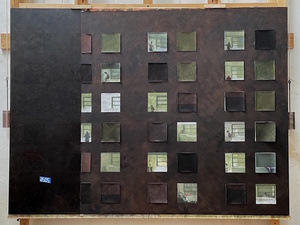
‘Hotel du Monde’ in progress 2026 oil on linen with temporary scanned photos 1470x1980mm
Fifty(!) years ago I made ‘A Search for the Man in the Street’, which, in its complexity, is a little like ‘Hotel du Monde’. It too included a constructed window but with a painted view of a wall on a housing estate. Below this window I made an A5 card index and these 30 cards included incidents, some real and some imagined, in and around that wall.
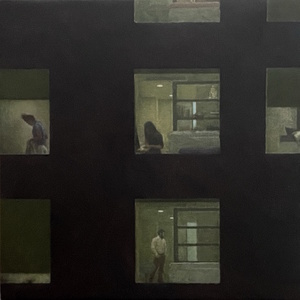
‘Hotel du Monde study (iii)’ 2025 oil on linen 500 x 500mm
I’d like to conclude by quoting the art critic Marina Vaizey talking about ‘A Search for the Man in the Street’ in Art Review, April 27th 1979 ‘…a substantial, intriguing and complex meditation, both hilarious, touching and profound, in the form of his own drawings, photographs and texts reproduced on index cards.’
I’m a bit late but thank you Marina.
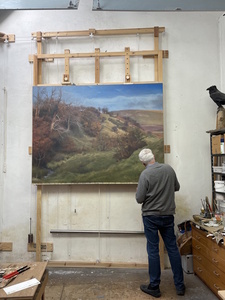
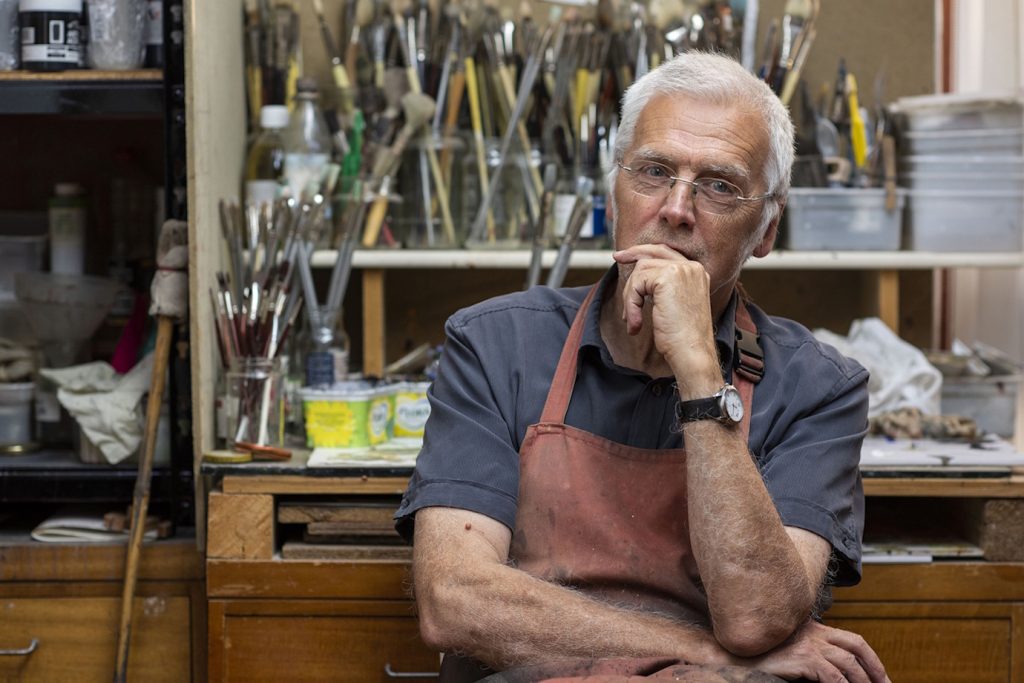
In the painting studio 2025
Contact:
Alan Stones, UK
Email: alan@alanstones.co.uk
Website: https://www.alanstones.co.uk
Deborah Blakeley, Melbourne, Australia
Interview by Deborah Blakeley, August 2026
Images on these pages are all rights reserved by Alan Stones

Think a colleague or friend could benefit from this interview?
Knowledge is one of the biggest assets in any business. So why not forward this on to your friends and colleagues so they too can start taking advantage of the insightful information the artist has given?
Other artists you may be interested in: