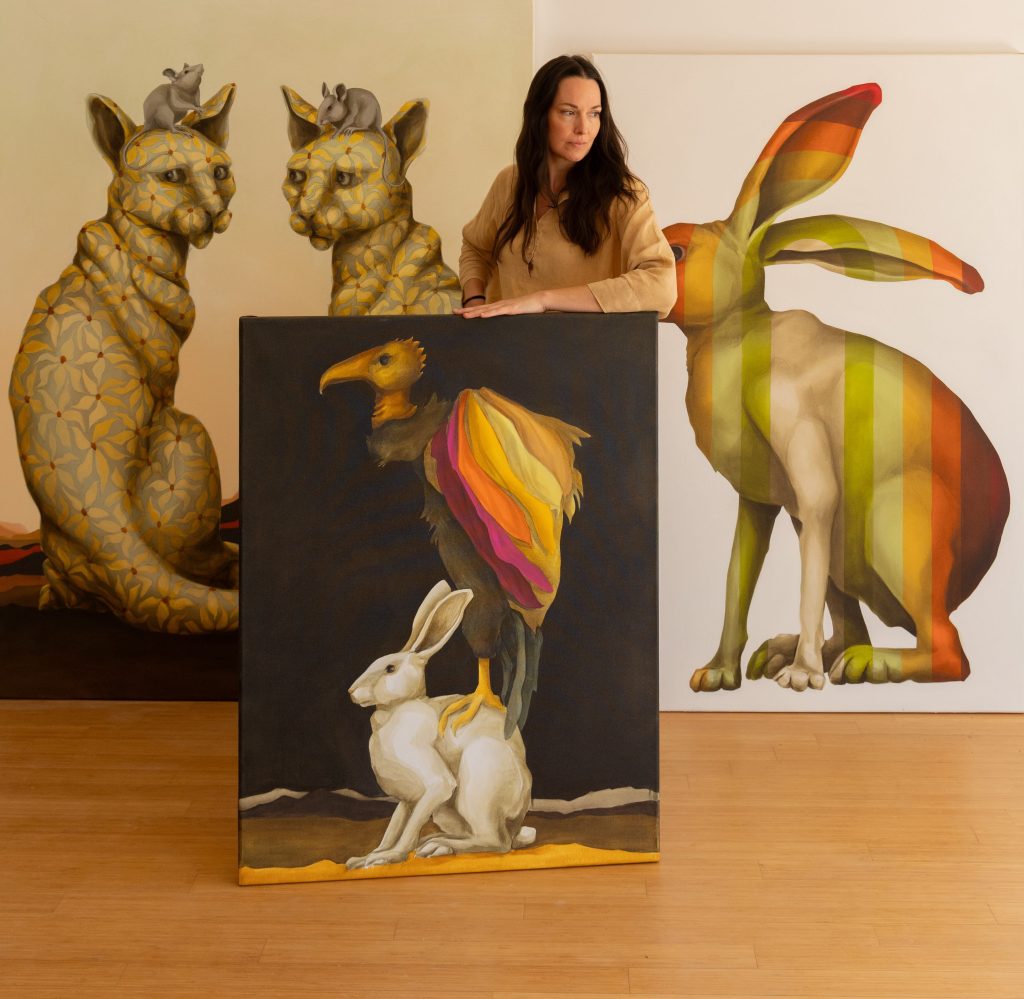
Sarah Edwards Painter
Tell us about your extensive training at University of California – Berkley, Massachusetts College of Art and Design and your fellowship in painting from Yale.
Massachusetts
I started my undergrad at Mass College of Art and Design in Boston studying conceptual design and Fashion. This foundation gave me a great sense of visual storytelling. While I enjoyed the technicality of construing garments, I found myself pulled much more toward the element of illusion and painting that came with designing clothing. After two years in the design program, I decided that I didn’t want to pursue a career in fashion and that I’d rather dive into fine art, specifically painting.
Berkley
From Boston I transferred to the art practice program at UC Berkley after taking a year off and working at an art gallery in California. This is where I really fell in love with painting. I also minored in print making at UCB, the processes of which still inform the way I paint today. Using layers in my paints like screen printing.
Yale
While at UC Berkeley I was awarded an Ellen Battell Stoeckel fellowship in painting. I was invited to spend the summer in Norfolk Connecticut working with the MFA faculty of Yale School of Art.
This fellowship was hugely important for me in that it challenged my work and the ideas behind it with a kind of academic rigor that I had yet to encounter. I experienced the brutality of masters level critique while still in undergrad! I was also working alongside some of the most talented young painters from universities all over the country.
What has led you to splitting your time between New York and Marrakech?
I started spending time in Marrakech in 2018 because my partner is Moroccan, and he had recently moved back after living in Europe and the US for many years. We are now raising our daughter here and living on a 10 hectare farm that we have developed over the past several years. With my daughter in school. I am mainly based in Morocco at the moment with time spent in New York at a minimum.
How important was it for you to take time away from painting and recharge?
I have settled into a routine of painting that is very wave-like, especially since becoming a mom, and with multiple creative projects that I manage at our farm. I generally divide my time by months, working on full time farm production and then switching full time to my studio. I find it difficult mentally to jump in and out of working in my studio. What I need is to find blocks of time that I can submerge myself into what I am making. I think that in my life right now, it’s working in my studio that recharges me. Not the other way around
Expand on 2 or 3 animals that you have enjoyed painting?
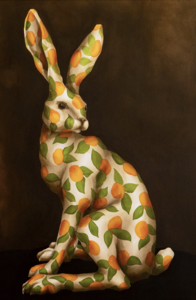
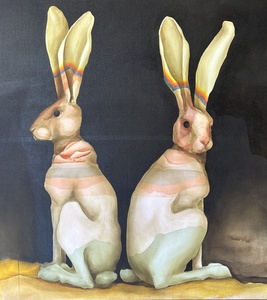
The animals that I have painted the most by far are hares. I find then elegant with beautiful expressive proportions, and intense eyes. Hares also hold a lot of meaning in folk stories and traditions around the world. I find that they are contextually “loaded” characters who offer different meanings to different viewers. Although they are small herbivores, they are powerful athletes, fierce and mysterious.
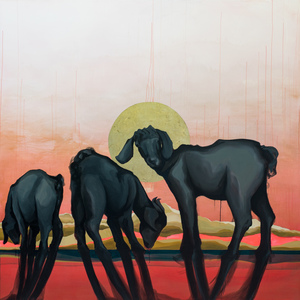
I also enjoyed painting the sheep and goats who live on our farm. These characters feel very different than the fiercely independent hares. To me, they symbolize humans’ grasp on nature and the way in which we impose control over nature, animals, and generally those less powerful. I believe that our animals have a very nice quality of life, however they have still been domesticated and stripped of independence over generations. They offer themselves as symbols of the power dynamics that are imposed on people and animals alike.
What led you to know you wanted to have a professional career in art?
I knew I was and artist from the time I was in kindergarten. As I got older I always assumed that I would pursue a career in the arts in so aspect whether design, fine art etc. Art is the bedrock of my life, when I have been in difficult places and felt lost, it is the thing that I have kept turning my focus back to again and again. When I moved to New York I had to organize my life around what I needed to do so that I could afford a studio. So essentially my career has been composed of a series of decisions that have enable me to keep painting.
How has your art changed and involved?
I think I am still learning how to paint and draw. I mean I have a good system and background, but I still struggle technically and need to constantly work on it. So, I can see that the more years I paint, the better the paintings get.
I feel like the process of making work has also become less frantic since I’ve been living and working closer to nature and in a place that has a very different pace of life than in a big city. I can see more detail and patience coming out of my painting.
Comment on how you use pattern within or on a subject.
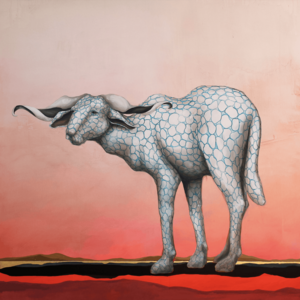
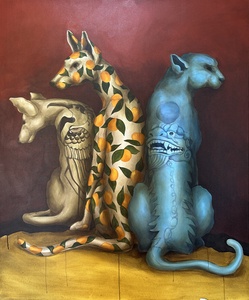
I think a lot about decoration versus camouflage and the difference between trying to blend in and stand out – there are such interesting social and existential reasons for doing both. I mainly take patterns that I see around me, textiles, plants, and reinterpretations of animal patterns. I find it interesting to adorn animals that tend to hide in their surroundings, to make them loud when they would otherwise vis blend in.
Shape is also a large aspect of your work – discuss.
When I am working on compositions, I pay attention to the way form interacts with negative space. For example, if put a large animal in the canter of a canvas I may have the arch of its back mirror the shape of the mountains behind it.
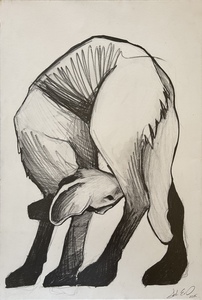
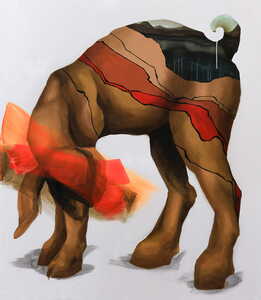
I also look at shape within the anatomy of the animals I paint and draw. I like to exaggerate proportions, perhaps a holdover from doing fashion illustration. It’s much more interesting to capture a dynamic form that one that feels static.
How and why, you overlap your drawings with splashes of colour?
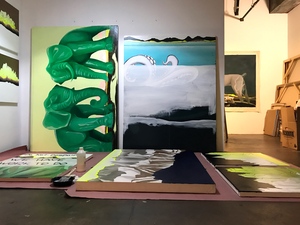
Lately I generally use landscape as background or as an interior world, when painted on a figure. As a background the landscape is quite traditional. Generally setting a ground for the subject. When painting on a figure the landscapes allude to how much exists inside individuals that is often hidden or ignored. The richness that makes up a life.
How and why, you overlap your drawings with splashes of colour?
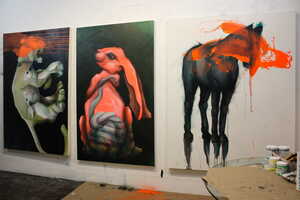
I have done less of the colour splashes lately, but these are important to me, and I feel I should go back to it. Obscuring subjects, specifically faces. Tells a story about the way we tend to treat animals as useful objects and tail to recognize their sentience.
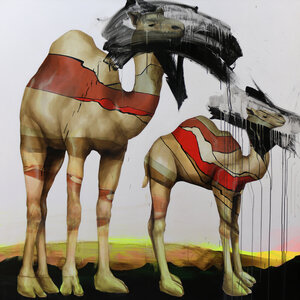
There is a broader theme that I’ve observed with the paint splashes, which speaks to beauty, decorate. And the role that beautiful things are expected to play in the world, Obscuring a decorative image subverts it in a way that changes its meaning different way to different viewers. Someone told me once after seeing a painting that it had been a beautiful piece and it’s such a shame that it was ruined by the paint splash across the animals face. A message that I have so frequently felt through my life is that something can be beautiful, or complex, but not both. The creatures (whether human or animal) that are expected to be beautiful are often also expected to be compliant an uncomplicated… frankly, think that is wrong.
Comment on the size of your work.
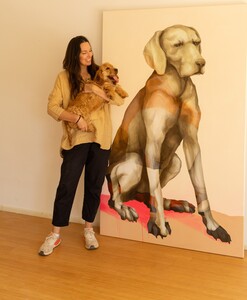
I love to paint on a large scale and I do so as much as possible. I think that the scale of an animal for example can completely change the meaning and impact of a piece. I usually try to paint any subject matter at its real size of larger. For me size also relates to take up space, which it is a conscious decision.
Contact:
Sarah Edwards
Website:
Email:
Deborah Blakeley, Melbourne, Australia
Interview by Deborah Blakeley, November 2026
Images on these pages are all rights reserved by Sarah Edwards

Think a colleague or friend could benefit from this interview?
Knowledge is one of the biggest assets in any business. So why not forward this on to your friends and colleagues so they too can start taking advantage of the insightful information the artist has given?
Other artists you may be interested in: