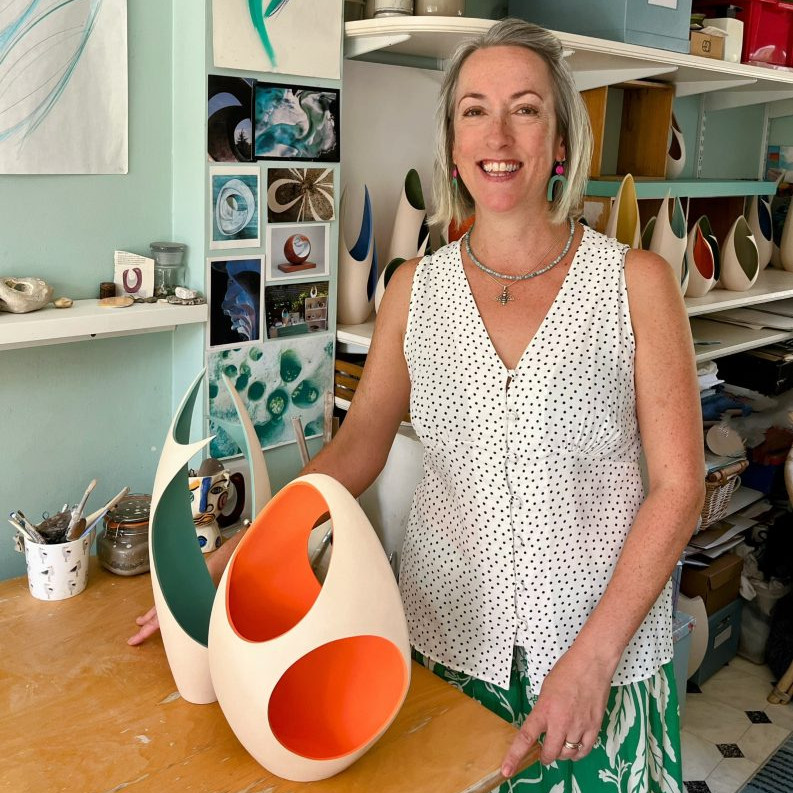
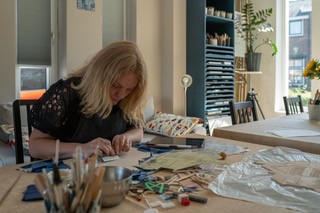
Alexandra Breeze Ceramic Artist. Painter,
After gaining your degree in ceramics and printmaking, what led you to combining house and ceramics?
I am originally from the UK and studied Ceramics with Printmaking at the School of Art and Design in Wolverhampton. After finishing my degree I completed a Postgraduate Certificate in Education at the University of London, which qualified me to teach Art and Design at secondary level in the UK. My husband is Dutch, and we moved to the Netherlands straight after my PGCE. I went on to teach in British international schools here, and my own work had to fit around teaching and raising a family.
When my children reached their teenage years, I found more regular time to return to making. I went back to night school to find that creative space again and focused on wheel throwing, a skill I hadn’t fully developed during my degree. I started carving Dutch canal houses into my thrown pots, partly to disguise their wonkiness. Friends and family loved them, and eventually people began asking me to make them.
Around that time, I decided to make some as a gift for my graduating Year 13 pupils. My wheel needed repairing, so I made them as tiles mounted on wood instead. That’s how the ceramic tile houses began.
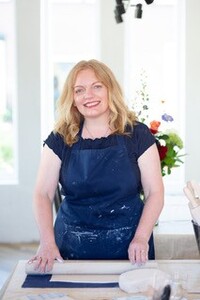
Comment on the architecture that immediately appealed to you in Amsterdam and why?
Living in Holland, I fell in love with the canal houses and the detail in their architecture. We’ve never lived in a traditional canal house ourselves. I used to dream about it, but I’m happy in my home now, with my studio attached, and I know I’d have to give up that space to live in one.
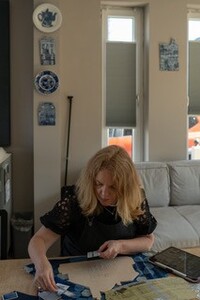
Comment on how you have been influenced by Dutch tiles.
My houses used to be finished with different coloured glazes and oxides, but cobalt blue was always the most popular and became my signature. I see it as a nod to traditional Delft blue tiles and ceramics. My details aren’t painted on though, they’re pushed in with various found tools, so the connection might be there, but the finished look is quite different from Delft blue work. What I love is that the Delft blue tradition itself comes from imported Chinese ware. The Dutch, like the Portuguese and others, tried to copy it, so there’s a whole history of interpretation behind the colour I’ve made my own.
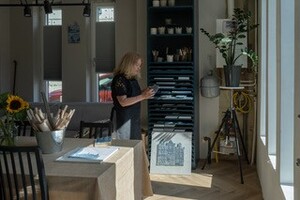
What are several of the architectural influences that keep drawing you back?
Dutch canal houses from the mid-17th century onward. Their façades vary enormously depending on the architectural fashions of the time, and gables in particular were the most prominent decorative feature, often changed by owners to keep pace with new styles. I love looking at and recreating those details in my tiles, using textures from buttons, beads, bottle tops, and other found materials.
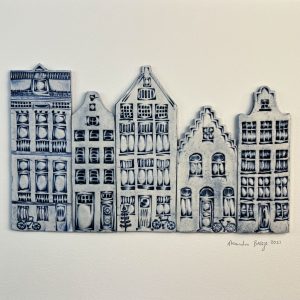
Amsterdam-Houses, 300 x 300
What is the thickness and weight of a finished tile?
The finished tiles are between three and five millimetres thick. Depending on size, they weigh between 40 and 650 grams.
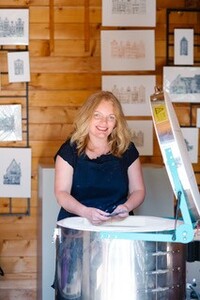
How did you come to the correct thickness and why?
When I first made them I used stoneware clay and they were thicker. Once I started working in porcelain I was able to make them much thinner. For a larger tile I’ll allow slightly more thickness. I can keep them this thin because they’re decorative rather than functional, though I have made one working splashback for my own studio.
Are your tiles always blue?
Blue is my signature colour, but I’m currently working on a commissioned puzzle piece in green, at the customer’s request, after they saw one I’d made for my own studio.
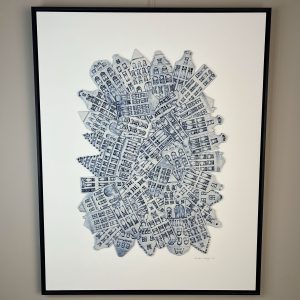
Haarlem Puzzle
Do you feel that not coming from The Netherlands has giving you fresh insight into the architecture?
I think because I first saw the canal houses as an adult, and it was a completely new experience for me, I really saw the wonder of it. We first lived in Leiden, and I remember walking the city with my children in the pram, in awe of the shapes and details, and loving that I got to call the place home.
Take two single houses and discuss three or four of the different architectural components. EG windows, doors
One of my favourite house shapes to make is the staircase gable, it’s a lovely one to work with in relief because of the stepped lines. Another piece I’ve made a few times is Shell’s head office building in The Hague.
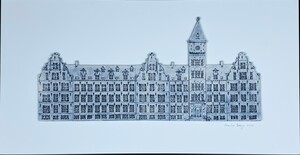
It was built in 1917, but it was designed to echo the same Renaissance and 17th century classicism I look for in the canal houses, with a thoroughly modern office behind that traditional façade. I’ve been commissioned to make this one several times over the years, usually as a leaving gift when someone senior at the company retires or moves on.
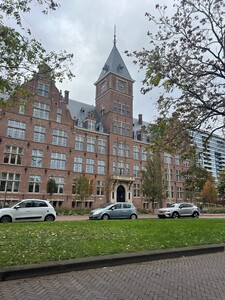
Amsterdam-Houses, 300 x 300
How large can you make your work and what are the restrictions?
For individual tiles I’m restricted by my kiln size, but because my tiles are so thin, I’d waste a lot of material trying to go much larger anyway. For bigger works I make pieces that fit together like a puzzle, and those have no real size limit beyond cost and time.
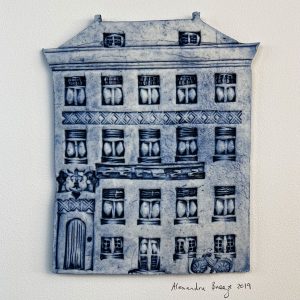
Leiden 300 x 300
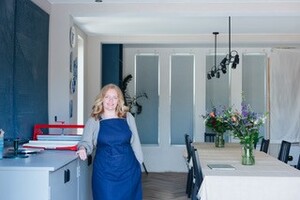
I hold workshops in my studio, which is attached to my home in Voorhout. I’ve also hosted them at the Mauritshuis museum (most famous for displaying the famous ‘Girl with the Pearl Earring’) and the American Embassy, and various businesses have asked me to run workshops for them, either on location or at my studio.
Where do you hold your workshops?
In my studio I can host up to twelve people, though I’ve taught larger groups at other venues.
Do you teach beyond The Netherlands?
This year I was a guest teacher as part of an art exchange with Laura Rainbow, an artist based in Croatia. I’m open to more exchanges like this in future.
How important has original Delft been in your artistic process?
The history of Delft ceramics has clearly shaped my colour palette, but the techniques I use to add texture and detail are very different. I love that as artists we all look to what came before us, interpret it, and develop it into something with our own voice. I’m especially happy that I’ll have the chance to visit China this year and have been selected to take part in the Taoxichuan autumn fair which is an clutural exchange event that takes part annualy in Jingdezhen with Terra Delft, a ceramic art gallery based in Delft.
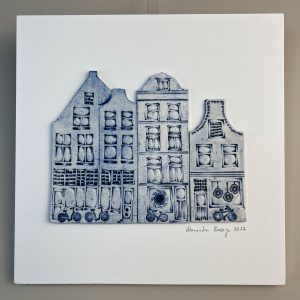
Delft Houses, 300×300
Do you take commissions?
Yes, I produce a lot of commissioned portraits of people’s houses and businesses, as well as pieces for relationship gifts and corporate gifts. I have made bespoke houses for people from around the globe.
What are your criteria for a commission?
I usually work from a photograph taken from the angle that the customer wants the building to be represented. It is always useful to have additional photographs to work from showing detail. Sometimes I will be asked to add a detail like an address or a date or a pet. A commission usually takes between 6-8 weeks to produce, and I discuss with the customer the progress at various stages so that they can have some input if required.
Tell us about a commission that has given you and the recipient much joy.
In January 2025 I heard about the wildfires in California and felt so sad thinking about people losing their homes. I knew someone who had been displaced by the fires, and hearing him talk about not knowing if or when he could return, but also about the support he’d had from people around him, touched with me. Not long after, I came across a post from someone I did not know who had lost her home completely, and I felt moved to offer to make her a tile of it, working from photos she sent me. When the piece arrived, she told me she couldn’t quite put into words how special it was to see the house captured so precisely from the photos alone. She mentioned her mother kept catching sight of it and smiling. Moments like that remind me these tiles aren’t just about admiring architecture, sometimes they’re about giving someone back a small piece of what a home meant to them.
Another piece that means a lot to me is the tile I made for the Butler House wedding venue in Ireland. It was commissioned by the mother of the groom, who ordered three: one for the bride and groom and one for each mother. She wrote to tell me it had been a wonderful occasion, and that the mother of the bride, who is a painter herself, had been moved to tears by the tile and amazed by how much detail could come through in it. Moments like that remind me why I love making these pieces, they end up woven into the memory of the day itself, not just a picture of the venue where it happened.
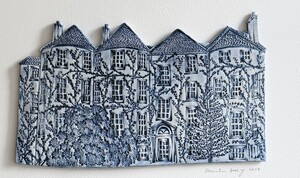
Butler House
Do you exhibit in Galleries and where?
This year I have exhibited at Ceramic Arts London at Kensington Olympia, Potfest in the Park at Hutton in the Forest and Potfest Compton Verney, two top tier events for ceramicists in the UK. I was also at the Dwingeloo Keramiekmarkt in the Netherlands and the Internationale Keramiktage Oldenburg in Germany. For the Delft Ceramic Days I was invited to create a piece for the Vermeer Centre called “Denkend aan Delft: Verbindingen door de Eeuwen” (Thinking of Delft: Connections through the centuries) and a tile jigsaw of Waterperry House, “Connecting Waterperry,” won the Spirit of Waterperry miniature competition at Celebrating Ceramics. I’m also a member of United Art Space which is an online art platform supporting artists.
This October I’ve been invited by Terra Delft to take part in the Taoxichuan China Autumn Art Fair 2026, and in November I’ll be at Art in Clay in Farnham, UK. My work has previously been shown in a number of local galleries and gift shops, and I’m now actively looking to move into larger, more established galleries. It’s the next step I’m working toward.
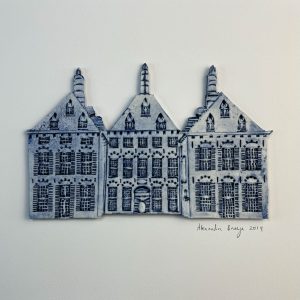
Kasteel Duivenvoorde Voorschoten. 300 x 300
Alexandra Breeze
Contact:
Website: alexandrabreezeceramics.nl
Email: alexandrabreezeceramics@gmail.com
Deborah Blakeley, Melbourne, Australia
Interview by Deborah Blakeley, August 2026
Images on these pages are all rights reserved by Alexandra Breeze
Deborah Blakeley, Melbourne, Australia
Interview by Deborah Blakeley, September 2026
Images on these pages are all rights reserved by Alexandra Breeze

Think a colleague or friend could benefit from this interview?
Knowledge is one of the biggest assets in any business. So why not forward this on to your friends and colleagues so they too can start taking advantage of the insightful information the artist has given?
Other artists you may be interested in: