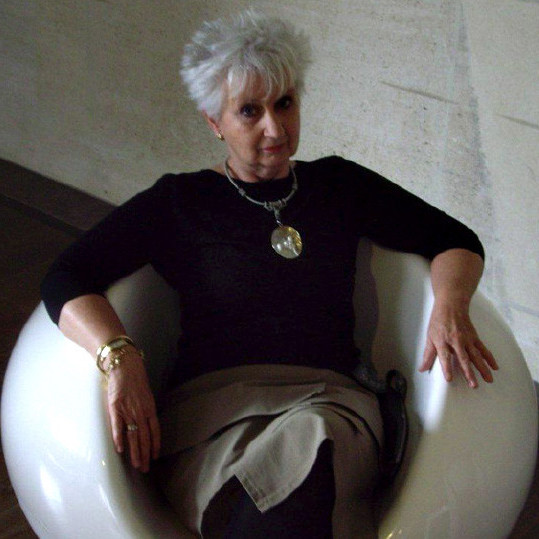

Heidi Woodhead Painter
Comment on the importance of tranquillity in your art?
Tranquillity is important in my art practice. The reason I began painting was as a counterpoint to the death and destruction I encountered daily in my work as a forensic crime scene examiner. I use my art practice to create a sense of tranquillity in my life and to create something beautiful amidst the chaos. I also use my painting to seek a moment of calm, a stopping place, time to reflect and pause and appreciate just being in the moment. I try to translate a feeling of calm in the paintings themselves, too, by using soft lighting, slightly blurring the lines, and choosing calming colours.
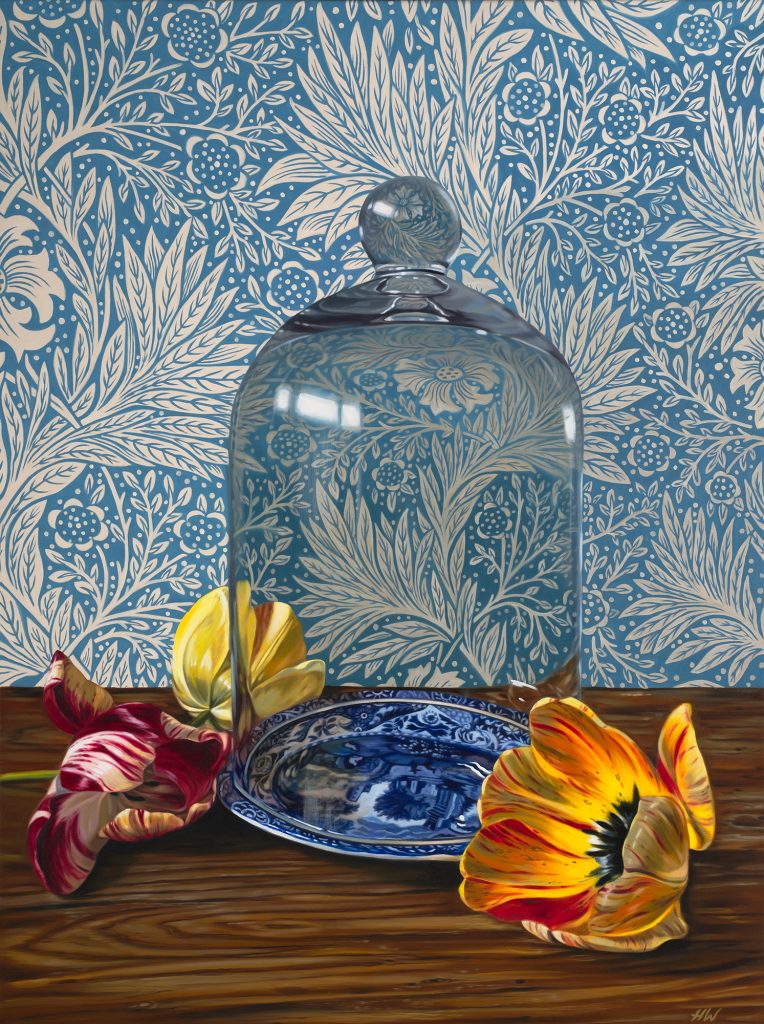 2023, All That I Am, 92cm x 122cm, oil on canvas
You do Still Life paintings, can you explain the importance of the frayed white cloth in many of your still life paintings?
In my most recent exhibition, Oceanic, I included a frayed white cloth in many of the paintings. This white cloth was representative of the ocean, in its form and undulating folds. Arranging the fabric in a certain way in my still life compositions suggested the movement of water, or the foamy turbulence of the ocean.
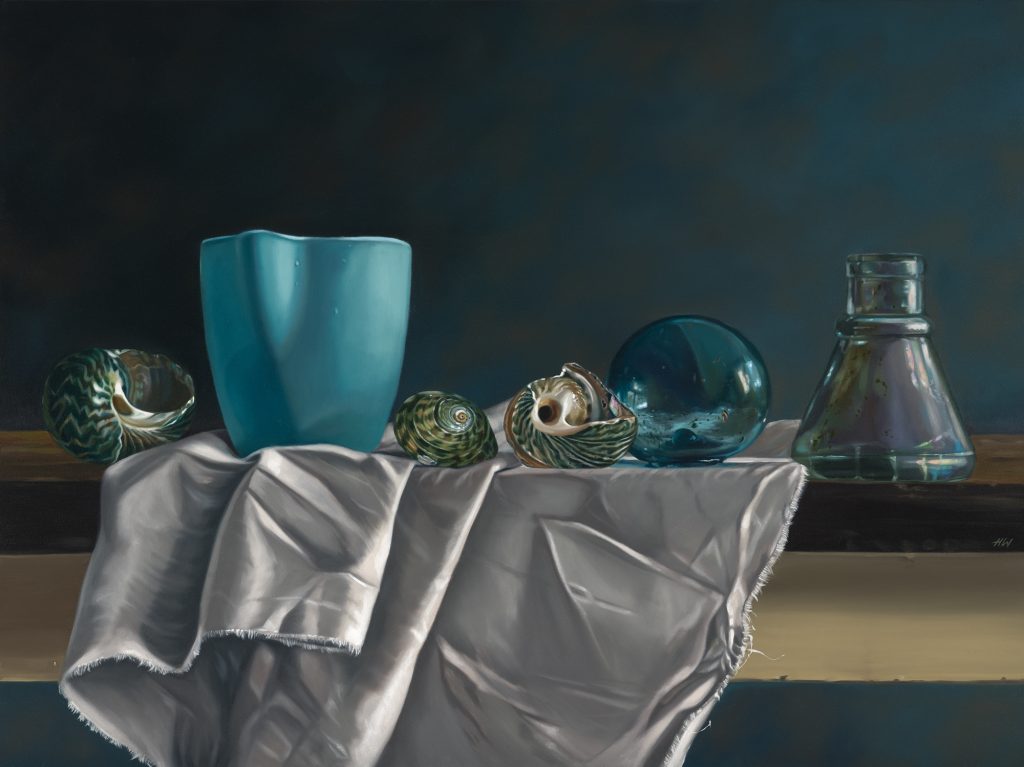 Ebb and Flow, 2025, oil on canvas,122cm x 92cm
Where do you get the pieces for your still life art?
I am a collector at heart and love fossicking through antique shops, garage sales and markets. I am always on the lookout for interesting bowls or ceramics, vases and plates. I also love collecting really time worn objects with patina and texture that speak to me of their history. When I am considering a piece to put in a painting, I usually pick something for the texture of the piece and how it might work in juxtaposition with the fruits or flowers I am putting next to it. Sometimes that is a piece of glassware that will bend the light in an interesting way, and sometimes it is a chipped old piece of crockery with a lovely, coloured glaze.
Your latest works, After the Rain, how do you include the silver leaf?
In of my latest works, After the Rain, I have included a background of silver leaf. This painting was inspired by the magnolia flowers that were coming out on the street where I live last Springtime. But Spring in Tasmania is notorious for showers and wind amongst the sunlight. I was trying to evoke the shivery, silvery bright sunlight that was being reflected on the recent raindrops of each petal. I developed the idea of the silvery light and applied a background of silver leaf around the magnolia image that I had painted.
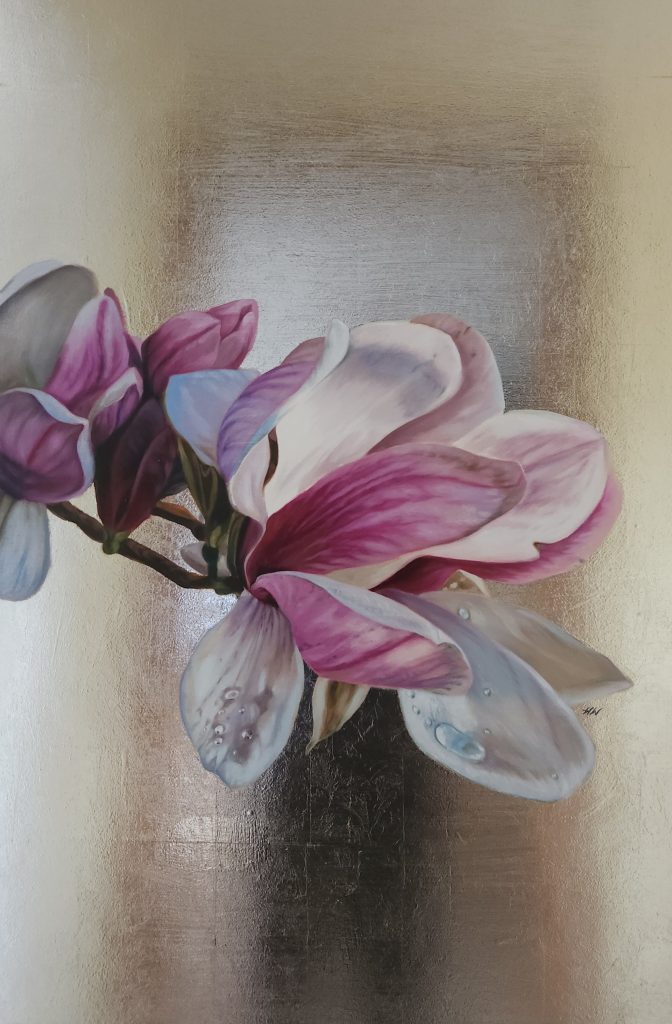 2025, After the Rain, 2025, oil and silver leaf on board
Does living close to the ocean influence the collection of shells in your work?
Living close to the ocean means that it is a constant inspiration. I swim in the sea regularly and find walking along the beach very meditative. Any time I visit a coastline I find myself collecting shells or bits or seaweed or feathers. I can’t seem to help myself. I find such immense beauty in the natural world, that I must pick up bits and pieces to take home and sketch later.
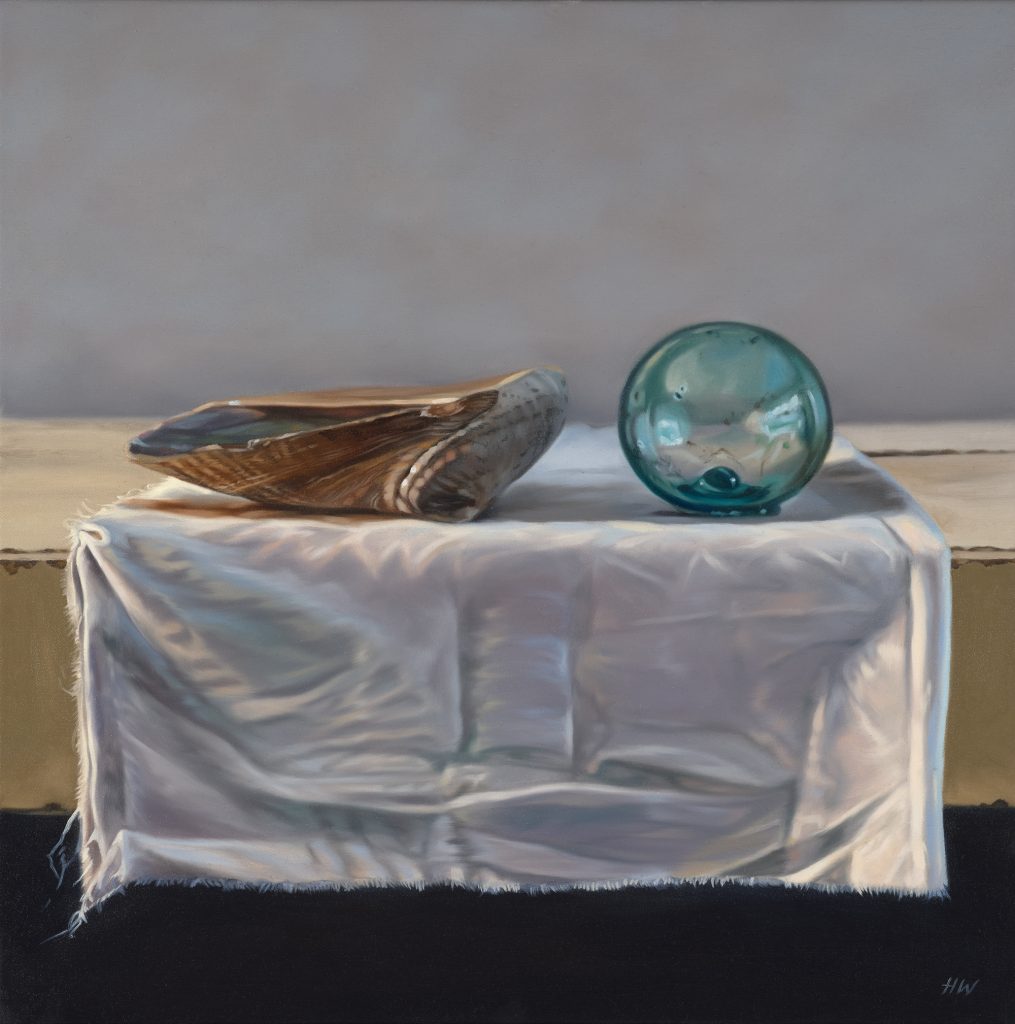 First Light, 2025, oil on canvas, 60cm x 60cm
Do you find your environment in Tasmania small or overflowing with inspiration?
I love Tasmania and I find it a very inspiring place to live. I like that it has a smaller community feel and I like living in a place of such enduring natural beauty.
Why do you choose to paint or draw various subjects?
The subjects I choose to paint, and draw come from a deep creative drive. I like to paint around a theme for each of my exhibitions and I arrive at a theme depending on what I feel inexplicably drawn to. For example, my last exhibition, Oceanic, was my response to an obsession with the ocean and wanting to communicate a sense of history with time-weary, ancient objects. I chose to paint shells, fragments of sea-pottery, ceramics and glass that symbolise the natural and man-made world and time passing.
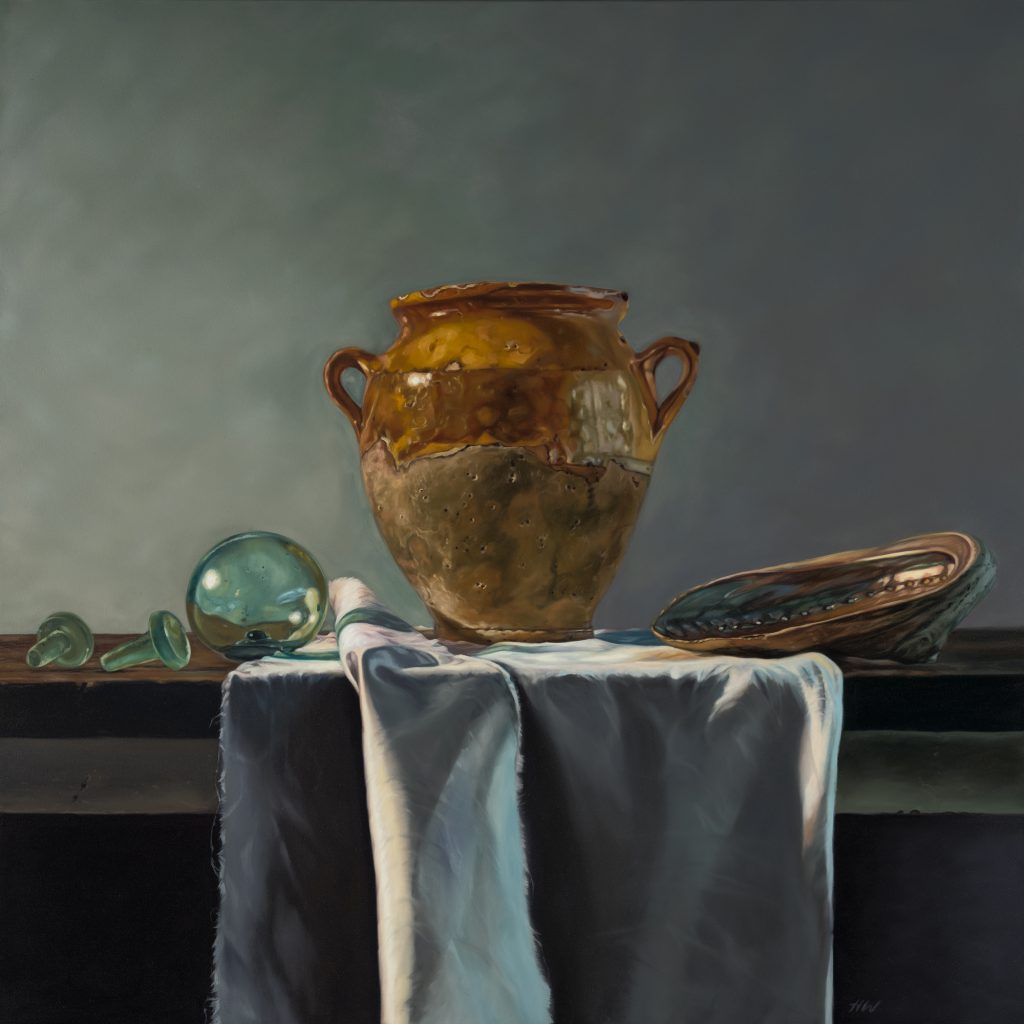 Stillness and Reflection, 2025, oil on canvas, 122cm x 122cm
By painting those objects, I was referencing our place in history and questioning its relevance in our contemporary world. My exhibition of 2023, Tulip Fever, was centred around the Dutch obsession with tulips in the 1630s. With that collection of paintings, I was tapping into that burning desire for beauty, of exploding colour and light with just a hint of the underlying darkness, a peripheral vulnerability not entirely apparent, giving a haunting quality to the work.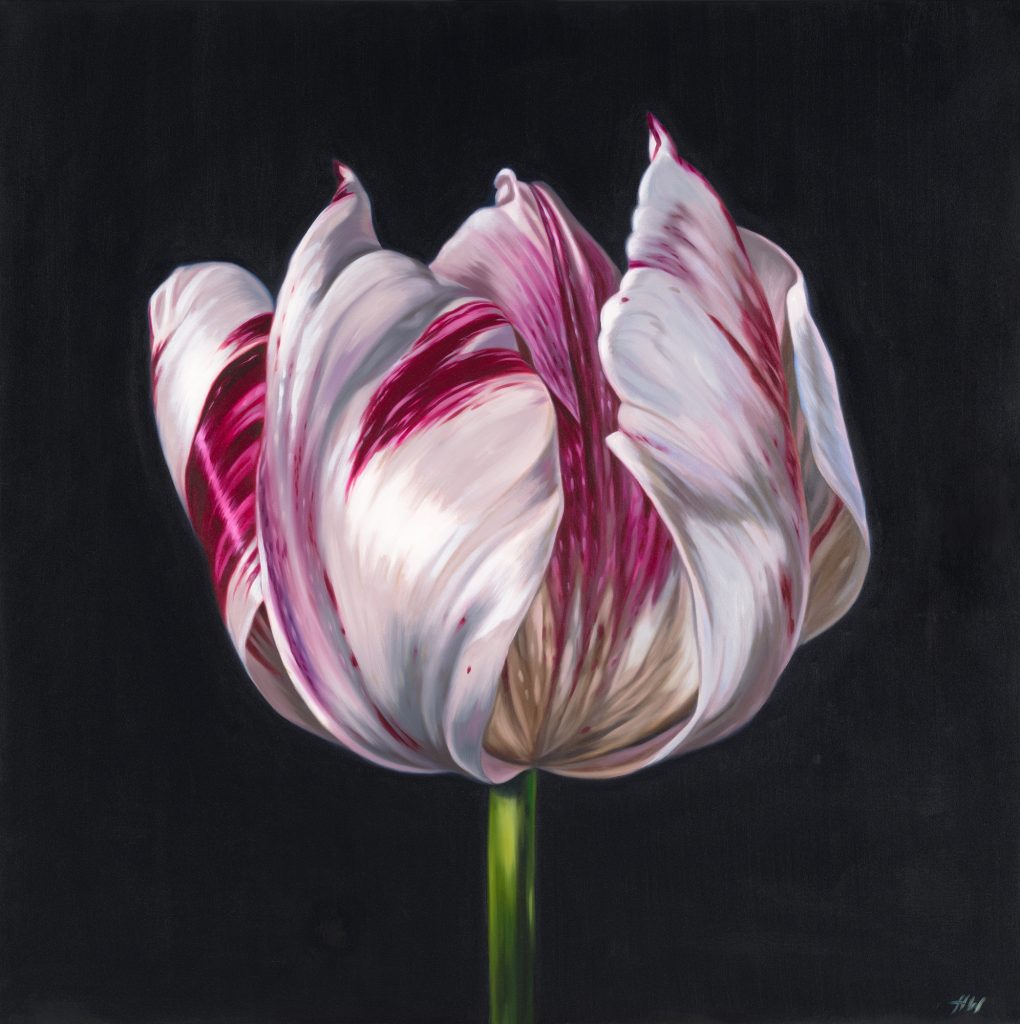 2023, Sempre Augustus, 122cm x 122cm, oil on canvas
Is your botanical art influenced by old Dutch masters.
My botanical art is very influenced by the Dutch Masters. I strive for a classical element to my paintings, and I look to the old masters of still life for inspiration, be it in their use of light and dark or their subject matter. I especially admire female artists of that time such as Rachel Ruysch and Anne Vallayer-Coster.
Discuss your painting ‘Oyster Catchers, Nelson Bay’.
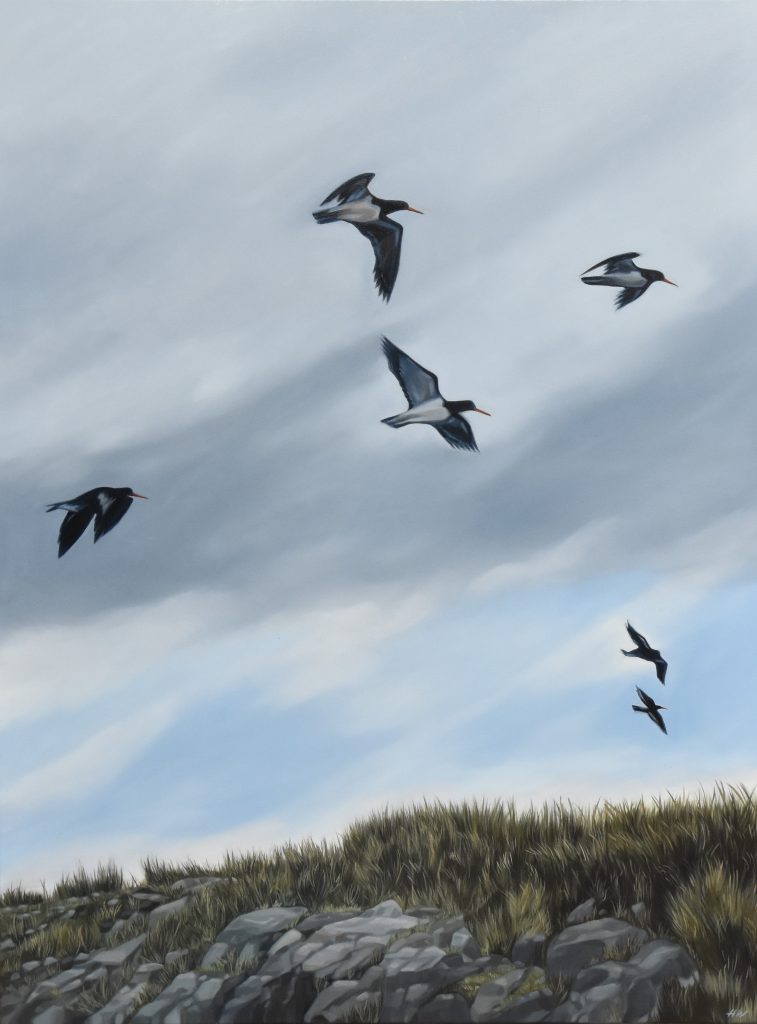 2024, Oyster Catchers, Nelson Bay, oil on canvas, 122cm x 92cm
Oyster Catchers, Nelson Bay is a painting I made after visiting the West Coast of Tasmania. I rarely paint landscapes, but I felt compelled to capture the wildness of that windswept coast. The location of the painting is Nelson Bay in North-Western Tasmania, just below Marrawah. I enjoyed the abundance of sea birds amongst the rocks and grasses and felt really exhilarated by the atmosphere.
What are you planning on painting in the future?
My next exhibition will be September 2027 at Handmark Gallery in Hobart. I am planning a series of still life paintings focusing on fruits and vegetables in more of a kitchen setting. I feel drawn to creating a beautiful simplicity, an organic aesthetic of speckled eggs, home grown apples, crumbling crockery, and blue and white china.
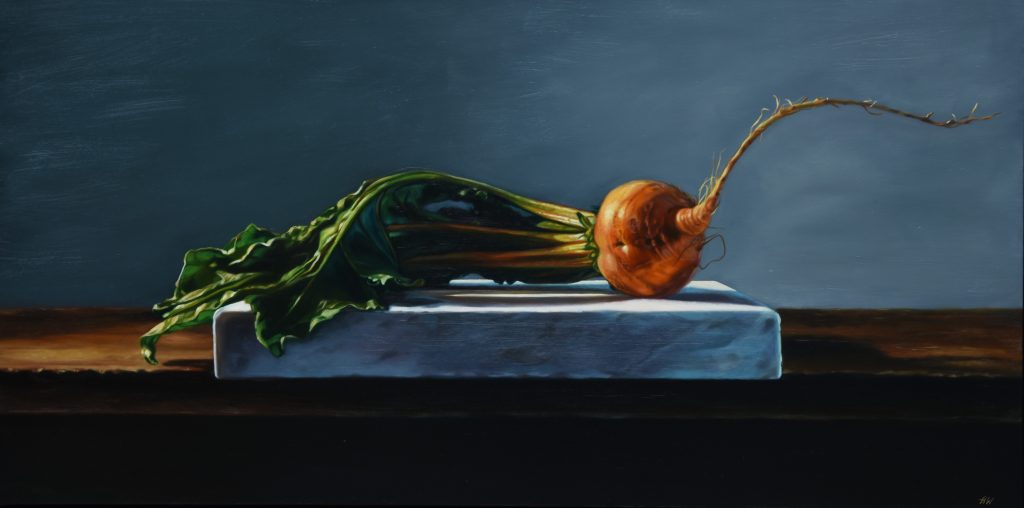 2025, Golden Beetroot, oil on board, 120 x 60
Explain the sizes of your works and why?
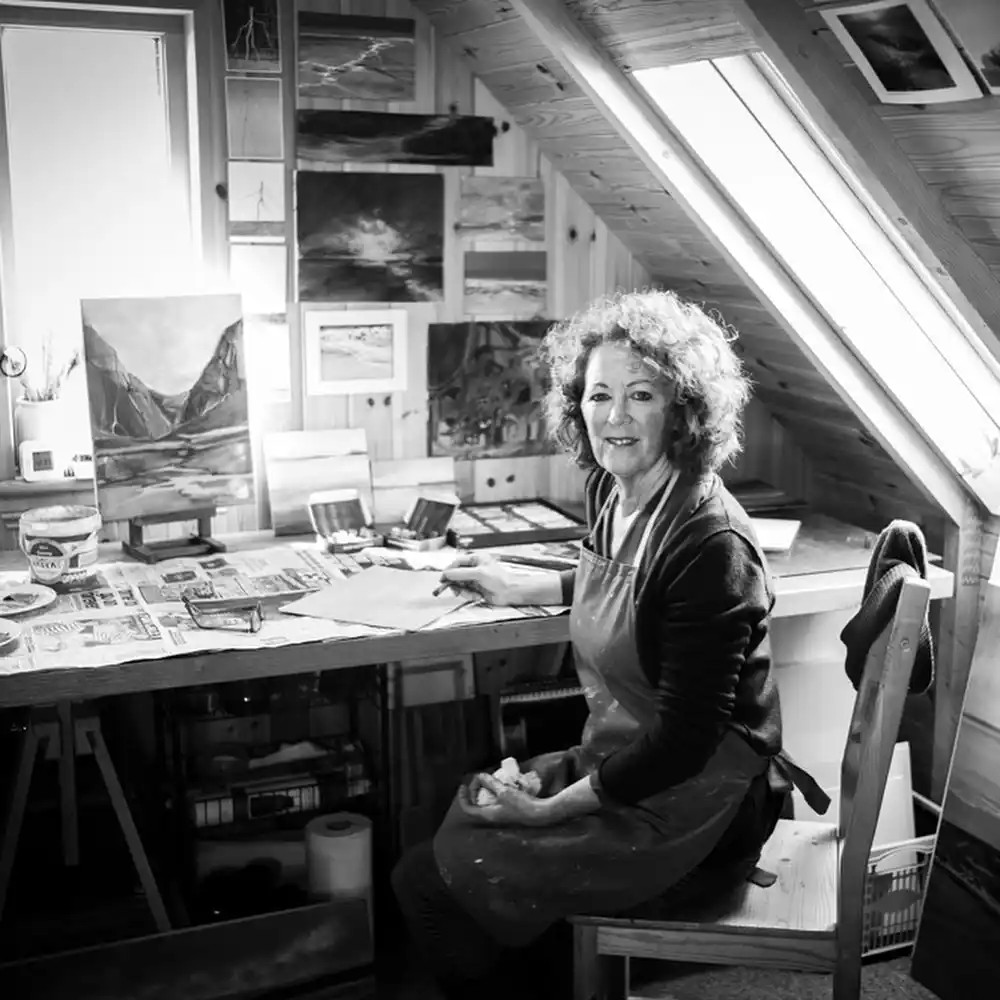
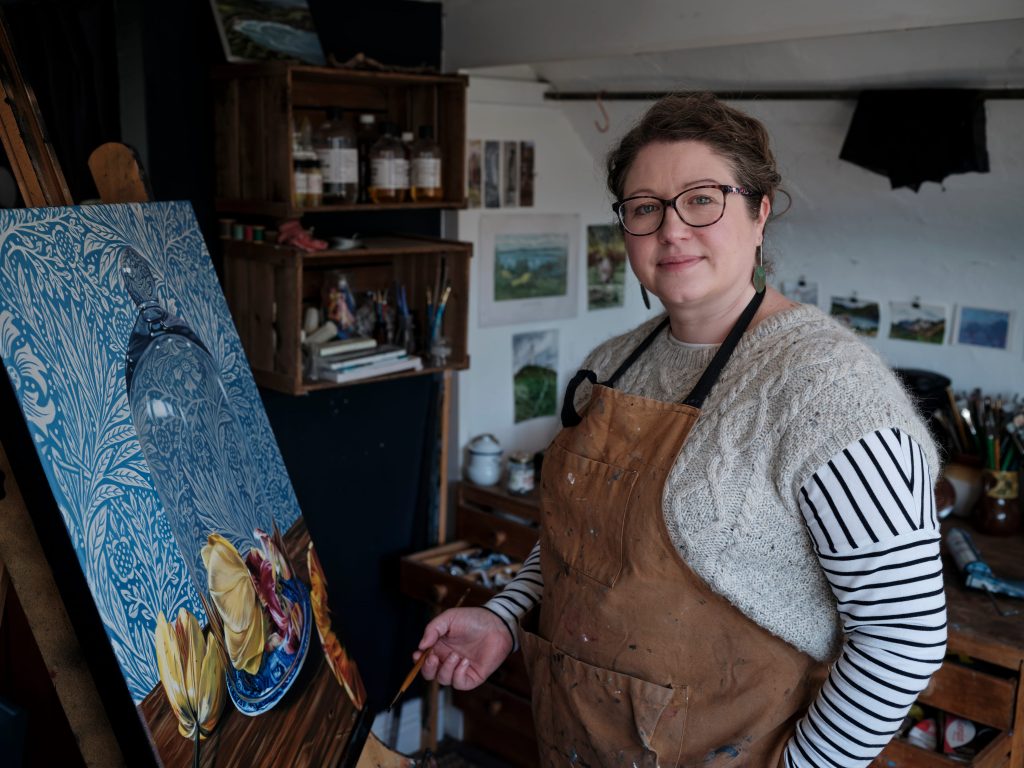
The size of the works I create is usually informed by the subject matter and how it speaks to me. I usually include a range of sizes but never very small or extremely big. I would say my sizes are more mid-range, which is what I feel more comfortable working with. It is also a matter of practicality in that my studio is in the attic of my old stone cottage, circa 1840-50, accessed by a very narrow staircase.
Where did you learn to paint and draw?
I don’t remember learning to paint and draw; it is simply something I have always done. I remember sitting at the table as a very small child painting with my mum and my sister. Over the years I have done various workshops, and I do a lot of self-directed learning if I am interested in a particular area (such as how to apply gold leaf). Painting and drawing is my way of making sense of my surroundings. I find it a balm and a challenge and each time I sit down to make art I learn something about myself and about the process itself.
Tell us what has regenerated your art recently.
I have recently become very inspired by the garden and interested in a more classical approach to still life composition. I find myself wanting to notice and capture more detail and look closely at my subject. I find it a challenge to capture different textures and surfaces too. I have a love of painting glass; I like the way it refracts light and bends shapes into something almost abstract. I have also been experimenting with glazed ceramics and different surfaces such as cloth and wood.
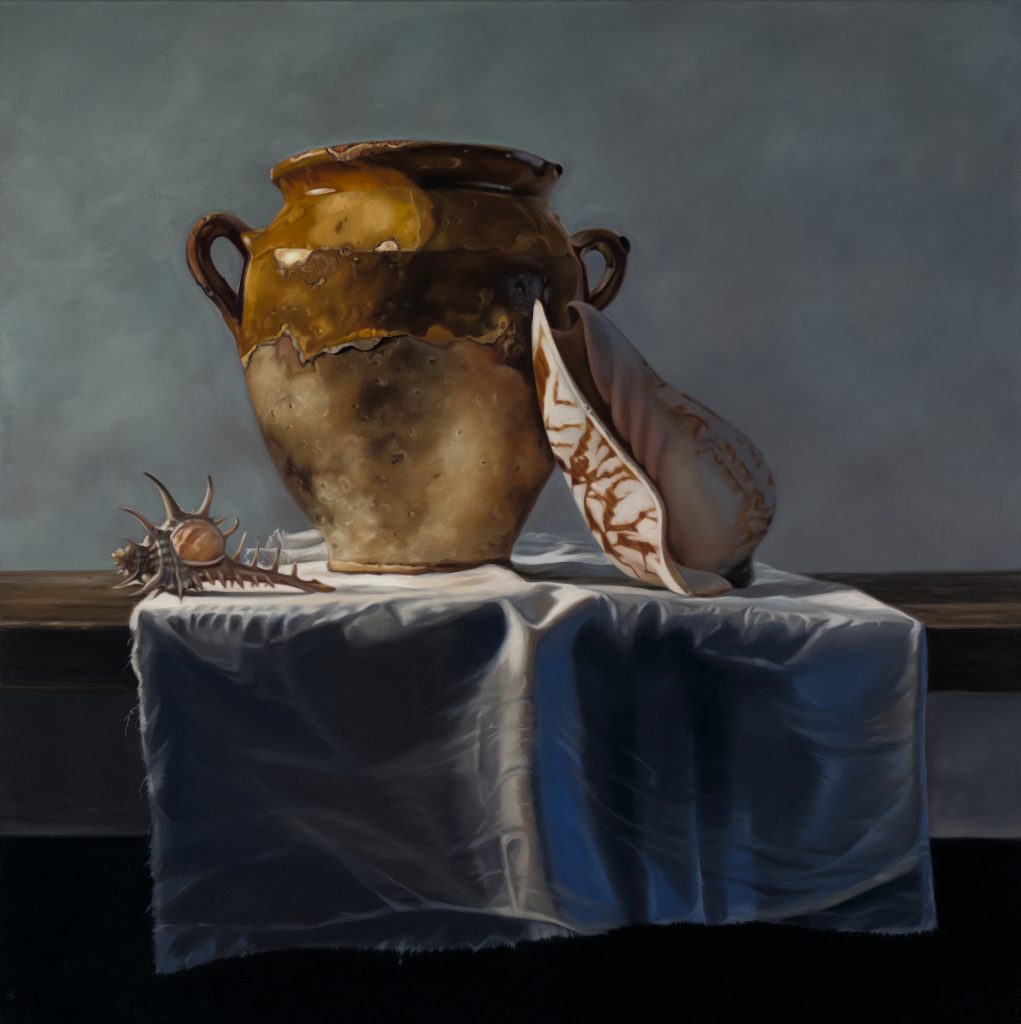 Tempests Rise, 2025, oil on canvas, 122cm x 122cm
Contact:
Heidi Woodhead
heidiwoodheadartist.com.au
heidiwoodheadart@gmail.com
Deborah Blakeley, Melbourne, Australia
Interview by Deborah Blakeley, February 2026
Images on these pages are all rights reserved by Heidi Woodhead

Think a colleague or friend could benefit from this interview?
Knowledge is one of the biggest assets in any business. So why not forward this on to your friends and colleagues so they too can start taking advantage of the insightful information the artist has given?
Other artists you may be interested in: